A template is somebody else's decisions, delivered finished. Some of those decisions are cheap to reverse and some are the whole site.
Surface, and structure
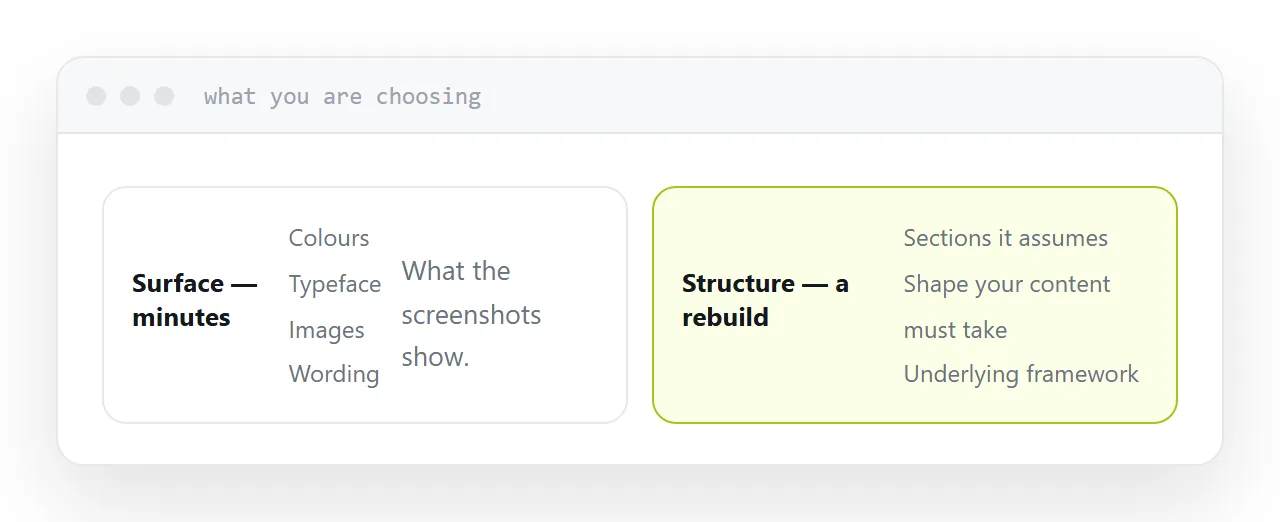
Surface. Colours, typefaces, spacing, images, wording. All changeable in an afternoon, and all of it is what the screenshots are showing you.
Structure. How many sections the page assumes, what shape the content has to be, how the navigation works, what framework it is built on. Changing any of that means rebuilding.
So judging a template by how it looks is judging it on the part that does not matter.
| Attribute | Cost to change |
|---|---|
| Colours | Minutes |
| Typeface | Minutes |
| Images | An hour |
| Section order | An hour |
| Page structure | A rebuild |
| Underlying framework | A rebuild |
Match the structure to your content
The common failure is choosing a template and then writing content to fill it.
A template with six feature blocks, three testimonials and a statistics band will get six features, three testimonials and some statistics, whether or not those exist. The result reads as invented, because it was.
Write down what you actually have first. Then choose the template whose shape resembles it, even if a better-looking one exists with the wrong shape.
Open the demonstration on a phone
Screenshots are taken on a wide desktop window.
Open the live demonstration on an actual phone. A large proportion of templates have a narrow layout that was an afterthought: text that overflows, navigation that covers the content, images cropped to nothing.
If the demonstration fails on a phone, yours will too, and fixing somebody else's layout is harder than writing your own.
Weight
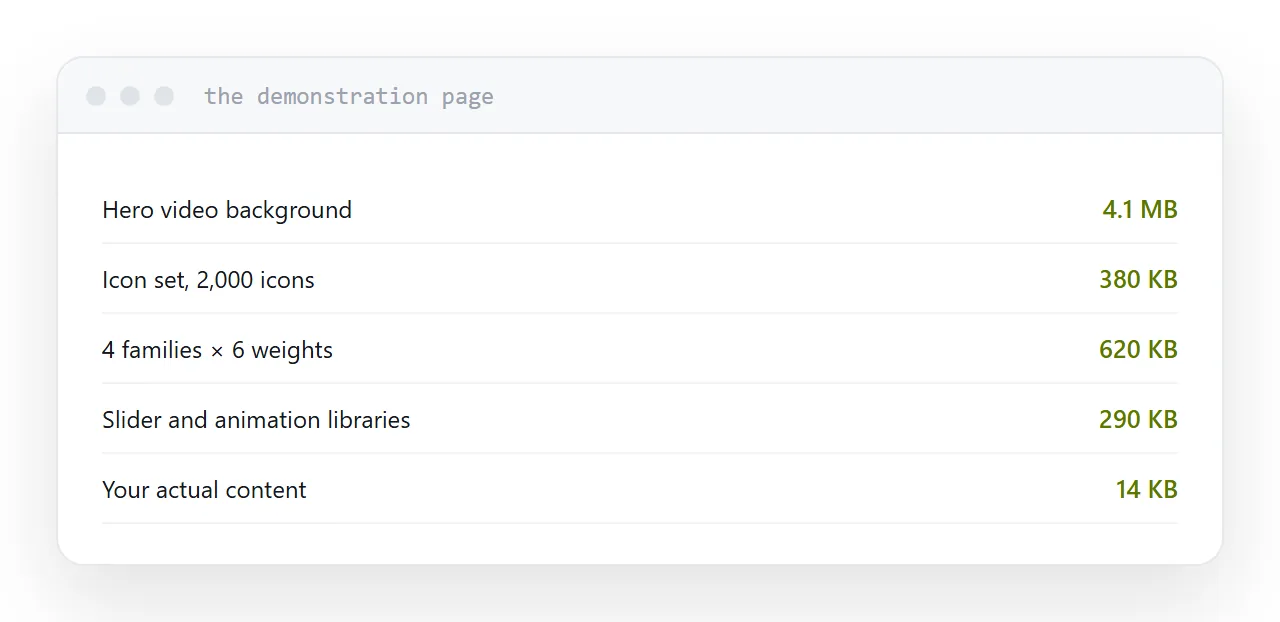
Templates are heavy. Sliders, animation libraries, icon sets with two thousand icons, four typefaces in six weights, a video background.
A template demonstration routinely weighs several megabytes. On a phone on mobile data that is a slow page, and page speed is one of the few technical factors that genuinely affects both ranking and whether people stay.
Delete what you do not use. Unused libraries still download.
Licences
Free templates frequently require attribution in the footer. That is a fair trade and it should be a known one.
Check also whether the template is maintained. An abandoned template built on an old framework version is code you now own, and the first time something breaks you are reading somebody else's markup to find out why.
For the surrounding ground, see How to build a static site and What a static website is.
Put it at an address
Open the demonstration on a phone, check the page weight, choose the structure that matches the content you actually have, delete everything you will not use, and read the licence before committing.