For a single static page, both options publish it for nothing. Choosing is about which machinery you take on with it.
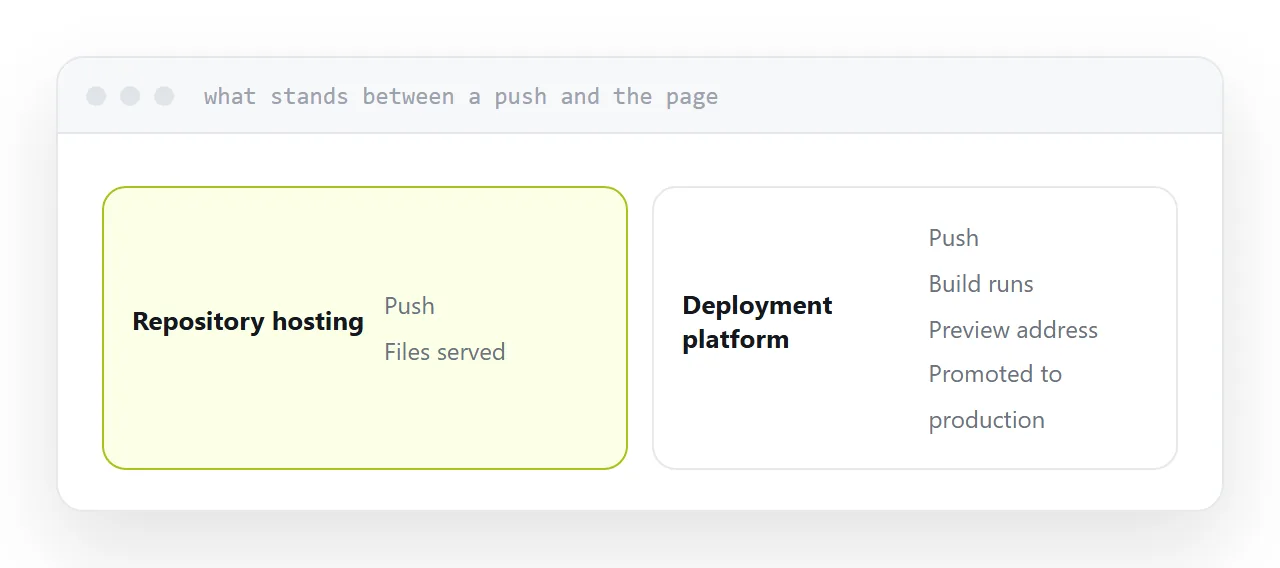
What repository hosting does
It serves the files in a branch or folder as a website.
No build unless you add one, no server-side code, no preview addresses. Push, wait a few minutes, it is live. A custom domain is supported and free.
For a finished page, a documentation set or a portfolio, that is the complete list of requirements, and the absence of everything else is the feature.
What a deployment platform adds
A build runs on every push. Every branch gets its own preview address. Server-side functions are available. Deployments can be rolled back individually.
On an application under active development this is genuinely valuable and worth the setup.
On a page that changes twice a year, it is a pipeline maintaining a document, and the pipeline will break before the document does.
| Repository hosting | Deployment platform | |
|---|---|---|
| Build step | Optional | Central |
| Preview per branch | No | Yes |
| Server-side code | No | Yes |
| Rollback | By commit | One click |
| First publish | A few minutes | Under a minute |
| Cost for one page | Free | Free |
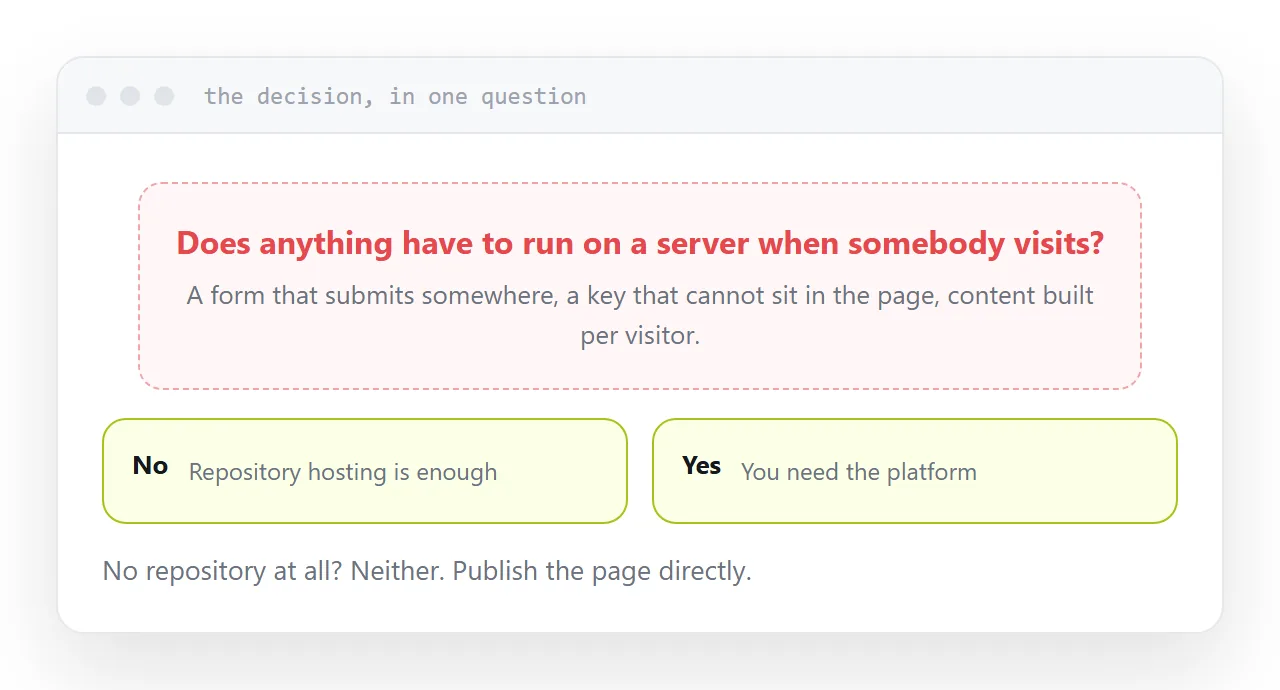
The decision in one question
Does anything have to run on a server when somebody visits?
If no, repository hosting is sufficient and will keep working with no attention for years.
If yes, a form that submits somewhere, an API key that cannot be in the page, content assembled per visitor, you need the platform, and that is the reason rather than any feature comparison.
The first-publish confusion
Repository hosting takes several minutes to appear the first time, and nothing announces it.
People push, load the address, see an error page, and conclude it failed. It was building. Wait five minutes before investigating anything, which is advice nobody gives and everybody needs once.
The case neither covers
Both assume a repository.
If the thing being published is a brochure, a price list or a one-page site maintained by somebody who does not write code, a repository is machinery wrapped around a document. Every correction becomes a commit, and corrections stop happening.
Publish it directly at an address instead. The same page, the same custom domain, and nothing in between the person and the edit.
For the surrounding ground, see Comparing two free static hosts and Choosing a GitHub Pages alternative.
Put it at an address
Check whether anything needs building, check whether anything runs on a server, expect the first publish to take minutes, add the domain record once, and skip both when there is no repository to justify.