Both take content and return a working address, which is why they end up on the same comparison page. Everything around that step assumes a different person.
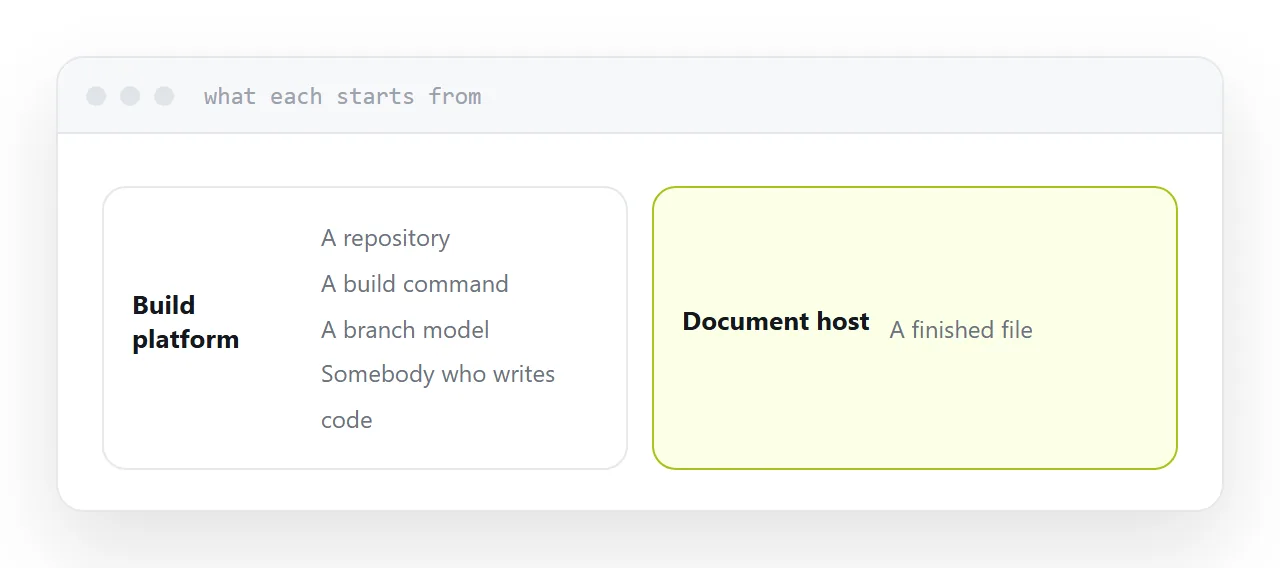
What each assumes
A developer platform assumes a repository, a build command, a branch model and somebody comfortable with all three. Drag-and-drop exists, and the rest of the product is built around the other route.
A document host assumes a finished page, no build, and a person whose job is not this. The interface has correspondingly less in it.
Neither is better. They are answers to different questions, and the comparison table hides that by listing features both have names for.
| Build platform | Document host | |
|---|---|---|
| Starts from | A repository | A finished file |
| Build step | Expected | None |
| Custom domain | Usually free | Usually paid |
| A correction | Commit, push, rebuild | Edit the page |
| When it breaks | Developer language | Plain language |
| Grows into | A full pipeline | Stays simple |
The free tier question
Developer platforms are generous, and a custom domain is often included where document hosts charge for it.
That is real. It is also not the full price. If connecting the domain means editing records you have never seen, and the guide assumes you know what a build output directory is, the free option costs an afternoon rather than a subscription.
For somebody who writes code, that afternoon does not exist and the free tier is simply better. For somebody who does not, the paid option is often the cheaper one.
What failure looks like
This is the part no comparison covers and the part that decides how the week goes.
On a developer platform, a failed deployment produces a log. The log is accurate, detailed and written for a developer. If you are not one, it is a wall.
On a document host, the failure modes are fewer because there is less machinery, and the messages are written for the person likely to be reading them.
How a correction happens
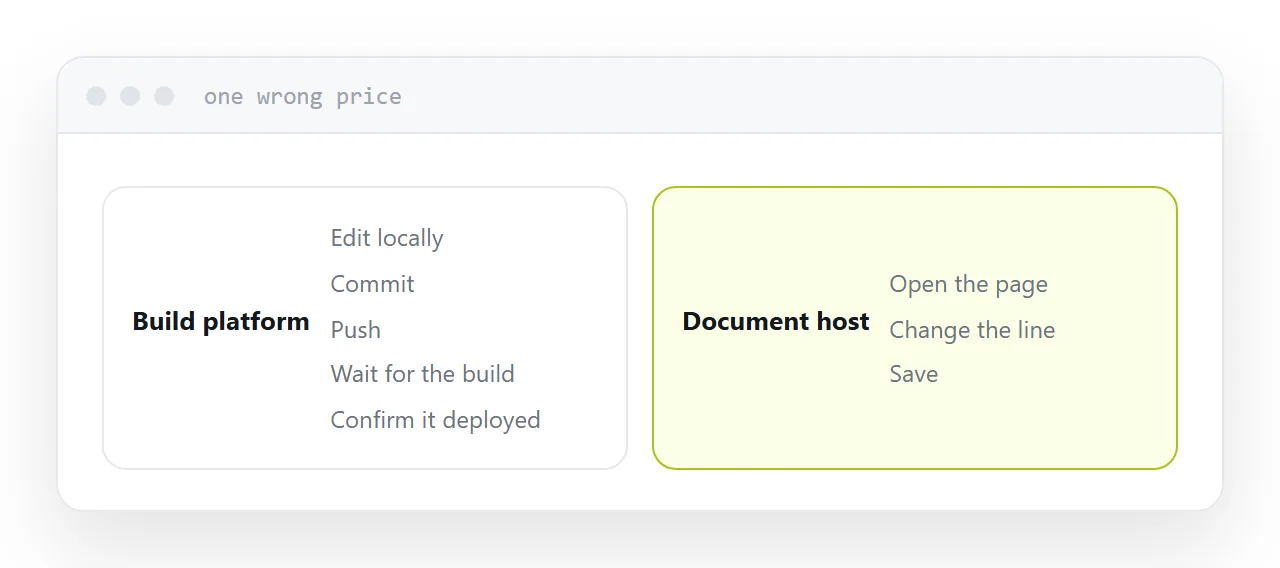
A price is wrong. The page needs one line changed.
On a build platform: edit locally, commit, push, wait for the build, confirm it deployed. Routine for a developer, an obstacle for anyone else, and it is why pages on developer platforms often sit stale.
On a document host: open the page, change the line, save.
The frequency of corrections is what makes this the decisive difference rather than a detail.
If this is near what you are doing, Comparing the quick ways to publish a page and Comparing two free static hosts cover the cases on either side.
Put it at an address
Decide by who maintains the page, count setup time alongside price, look at what failure reads like, look at what a correction takes, and ignore the features neither of you will use.