No AI generated website detector can prove a site was made by a model, and the tools that return a percentage are scoring the prose on the page rather than the page itself.

What works is a checklist. A visitor sees layout, copy and content rather than source, so the markers differ from the ones you would look for in a file.
What an AI generated website detector looks at
Two things get sold under the name, and they are not equally useful.
Text classifiers. Built to score essays. Paste a page into one and it evaluates the sentences. Marketing copy is short, formulaic and written to a template even when a person writes it, which is the worst case for this kind of scoring.
Pattern checklists. A person comparing the site against known habits. Slower, no number at the end, and considerably more reliable.
Neither yields proof. Both can support a judgement, which should be stated as one.
Be careful with how a result gets repeated. A checklist verdict passed on as a fact acquires a certainty it never had, and the people repeating it will not have seen the page.
The markers, and how much each is worth
| Marker | What you see | How much it tells you |
|---|---|---|
| No verifiable detail | No address, no names, no dates | High |
| Stock imagery only | No photo of anything specific | Moderate |
| Default palette | Violet or indigo accent, slate grey, one gradient | Low |
| Template section order | Hero, three cards, testimonials, pricing | Low |
| Unattributed testimonials | First name and initial, no company | Moderate |
| Every page the same depth | No page longer or shorter than the rest | Moderate |
| No history | No dated posts, no changelog, nothing older than launch | High |
| Fluent, unfalsifiable copy | Claims that could belong to any competitor | Moderate |
The two high value rows are about content, not design. A generated page looks generic. A page with nothing checkable on it is the one worth pausing over.
Verifiable detail is the real test
Hand built sites accumulate specifics because people put them there. A phone number that someone answers. A named director. An office with a street on it. A post dated two years ago about something that has since changed.
Generated sites are written in one pass with no history to draw on, so specifics are either absent or invented. Invented ones fail a search.
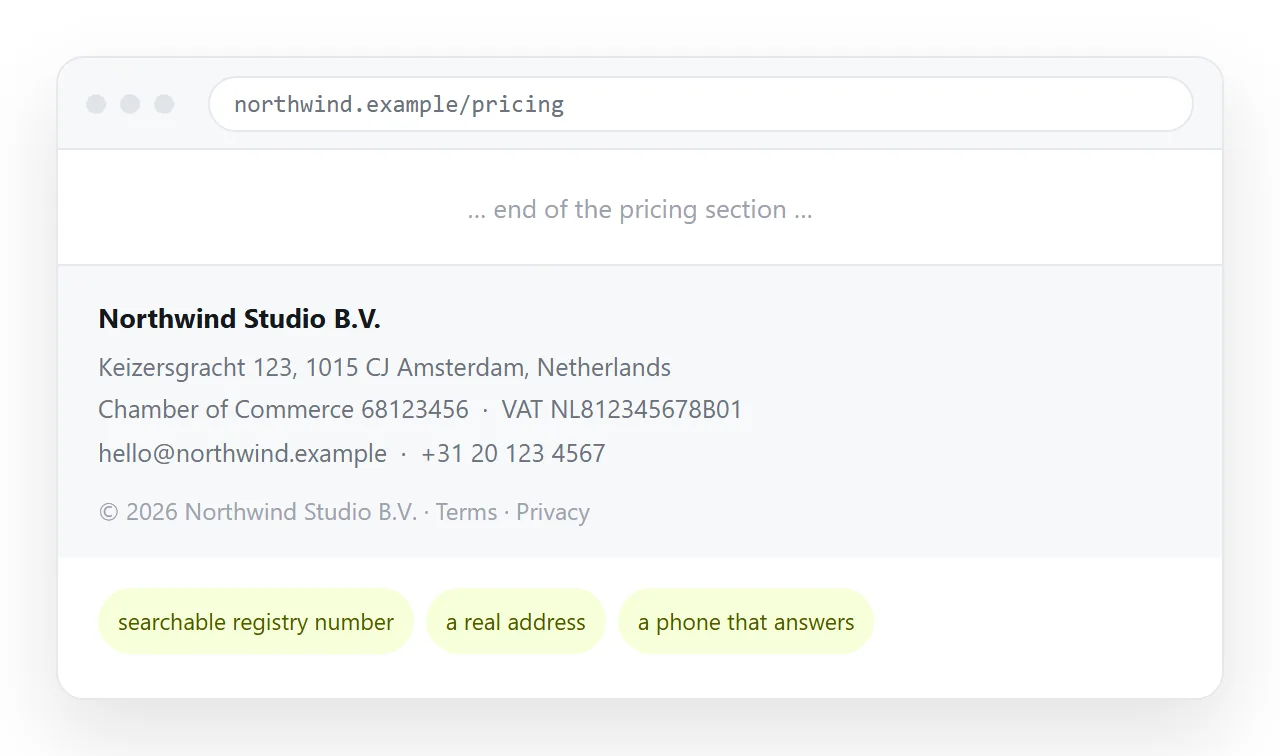
Three checks, in order of speed:
- Search the company name with the address and see whether anything independent comes back.
- Look for dated content. A blog that starts and stops in one month is a different signal from one with three years of gaps in it.
- Check whether the pages reference each other in ways a template would not, such as one page correcting another.
- Check whether the people named exist elsewhere under the same role.
Separate two different questions
The search usually mixes together a question about method and a question about trust, and only the second one matters.
Was this page generated? Often unanswerable, and usually irrelevant. Plenty of real businesses generate their pages, in the same way they used templates before.
Is there a real organisation behind it? Answerable, and the thing you actually wanted to know. It is decided by verifiable detail, not by visual style.
Judging a small company harshly because its page has a violet accent is a bad test in both directions. It flags legitimate sites and misses well made fraudulent ones.
The second half of that sentence is the important one. Anyone setting out to deceive has every reason to avoid the obvious defaults, so the sites most worth suspecting are the ones that look least generated.
If you are the one publishing
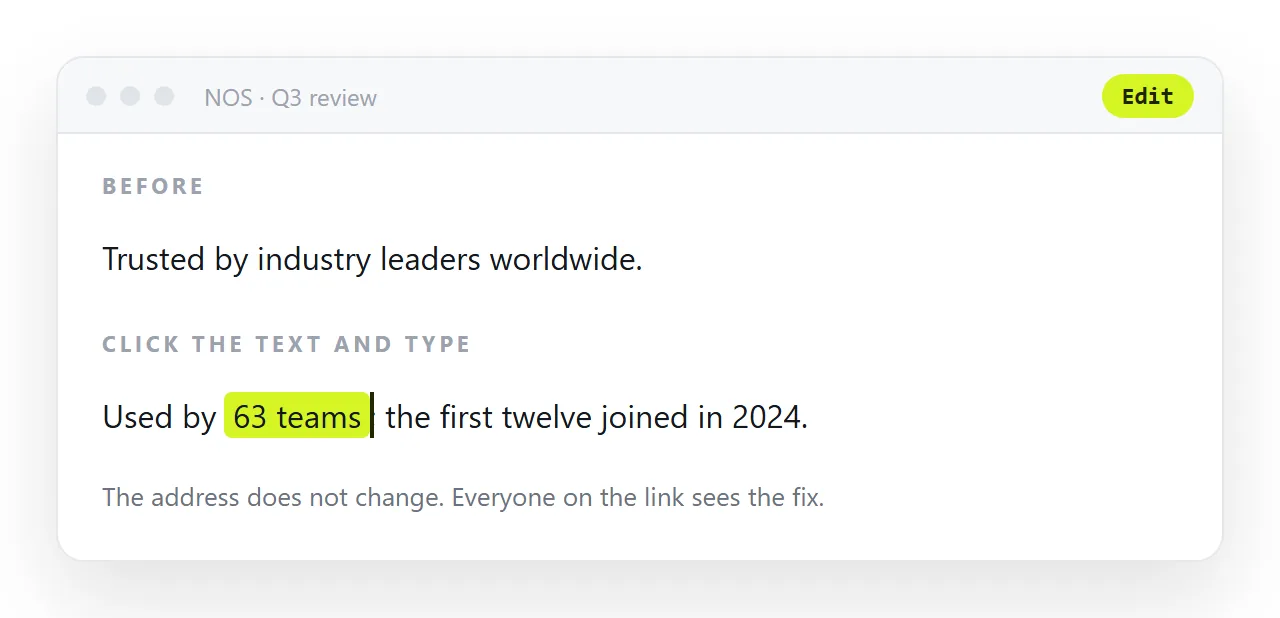
The same list tells you what to add. Put in the things a detector checklist would look for, because they are also the things a customer looks for.
- A real address and a company registration where that applies.
- Named people with roles.
- Photographs of something that exists, rather than stock.
- Dated content, and leave the old entries up.
- At least one claim that can be checked, with the source next to it.
On the visual side, replacing the palette does more than anything else, which is covered in AI HTML brand colours. The wider set of defaults, and the order to fix them in, is in why AI generated websites look the same.
Checking the source, and its limits
Viewing source adds a little. Explanatory comments above every section, byte-identical repeated blocks and a complete absence of dead code all suggest a single writing pass.
It is weaker evidence than it feels. Build tools rewrite markup, so on a modern site you are often reading machine output either way. The AI HTML code detector covers what the markup does and does not reveal.
If the site you are examining is one you have inherited and now have to maintain, the practical follow-up is not detection at all.
It is whether the pages render on their own and whether the content is correct, which is where fixing AI generated HTML starts.