No AI html code detector can prove that a page was written by a model, and anything claiming a confidence score for markup is scoring the prose inside it.
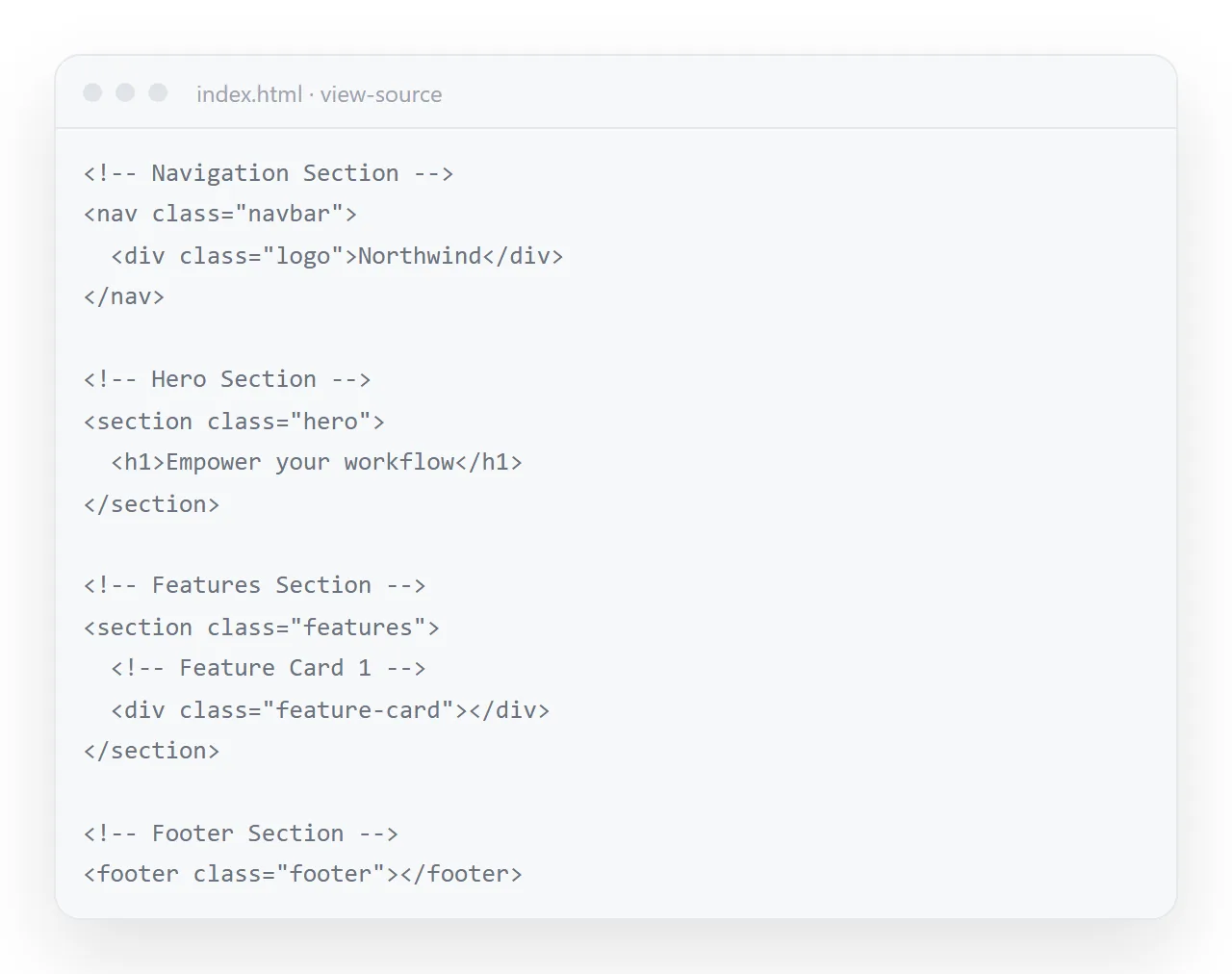
What does exist is a set of habits. Generated HTML tends to share structure, comment style and defaults, and once you know the list you can read a file in about a minute. Nothing on that list is evidence on its own.
What an AI HTML code detector can measure
There are two different products behind the phrase, and they do different things.
Text classifiers. Built for essays. Feed them a page and they strip the tags and score the sentences. The result says something about your copy and nothing about the markup.
Pattern checks. A person or a script looking for known habits. This is what actually works, within limits, and it is the rest of this page.
Neither can produce proof. Both can produce a reasonable guess, which is a different thing and should be treated as one.
The habits, ranked by how much they tell you
| Marker | What it looks like | Signal strength |
|---|---|---|
| Explanatory comments | A comment above every section restating its purpose | Moderate |
| Perfectly even structure | Every card identical, no accumulated exceptions | Moderate |
| Default palette | Indigo or violet accent, slate greys, one gradient | Weak but common |
| Placeholder copy left in | Lorem text, "Your Company", sample emails | Weak |
| Utility class storms | Twenty classes on a div, none reused | Weak |
| No dead code at all | No commented-out block, no leftover id | Moderate |
| Emoji as section icons | A pictogram before each heading | Weak |
The column that matters is the last one. Every marker here appears in careful hand written code as well, which is why the honest answer is a guess with a reason attached.
Why even structure is the real tell
Hand written HTML accumulates history. A section gets added under deadline, a class gets reused for something it was not named for, a wrapper div survives the layout it was built for.
Generated markup has no history. It was written in one pass, so every repeated block is identical and every name is the obvious one.
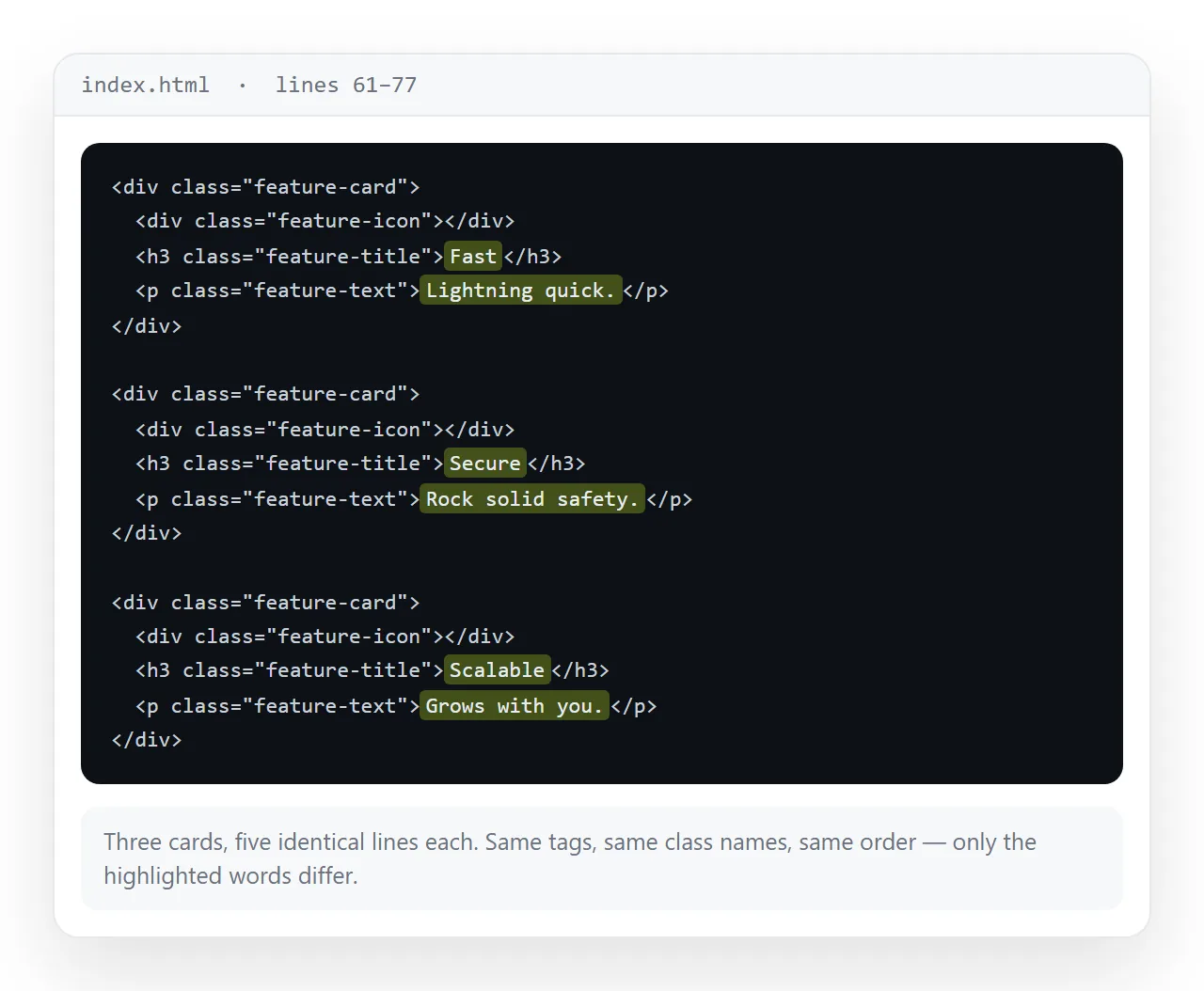
That evenness is not a defect. It is the reason generated pages are pleasant to edit. It is also the single most recognisable property of the output.
What to check instead of authorship
For almost every practical purpose, the question is not who wrote the file. It is whether the page works away from the machine it was written on. Three checks cover it:
- Does it render alone? Open it in the HTML file opener, a window with no knowledge of your folder. Missing styles or images show up immediately.
- Are the facts right? Generated pages fill gaps confidently. Every number, name, date and price needs checking against a source, because the markup gives no clue which ones were invented.
- Does it survive a phone? Check the viewport line is present and look at the page at narrow width.
The second is where real risk lives. A convincing layout makes wrong figures look reviewed.
Reading a file quickly
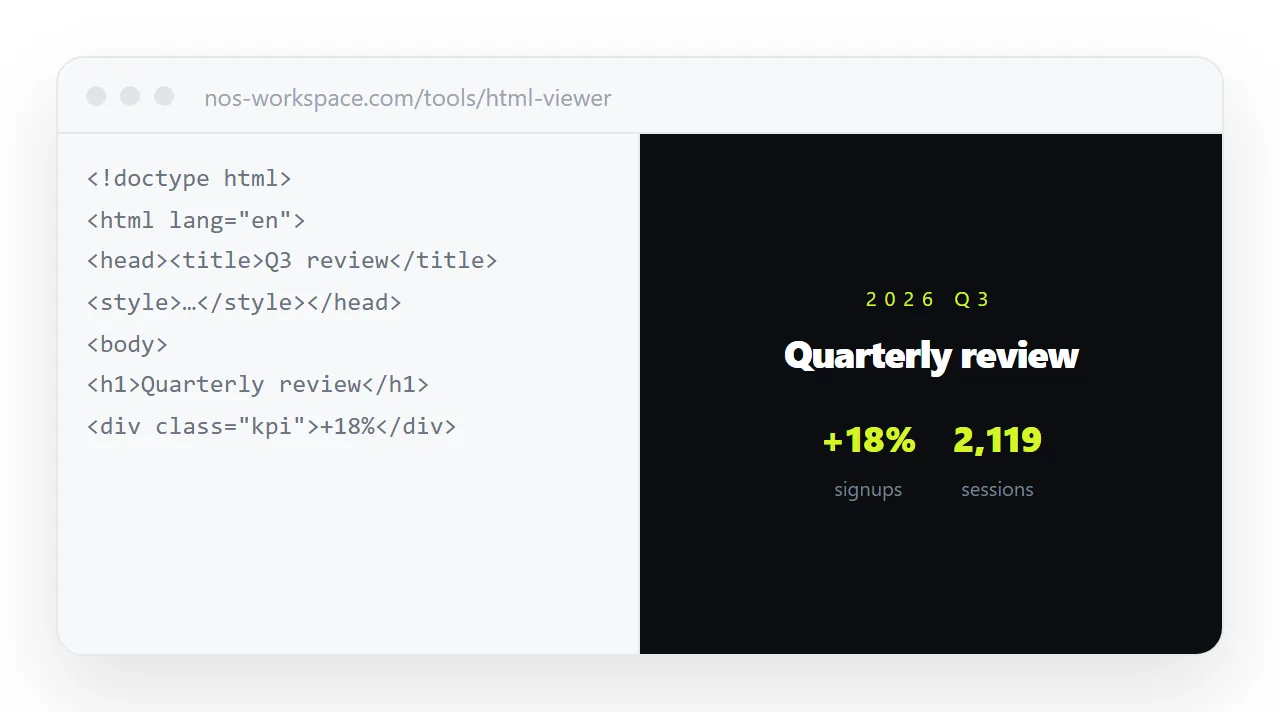
If you do want a judgement, this is the order that gets there fastest.
- Look at the head. A generated file usually has a tidy head with a title, a viewport line and a style block, in that order, with nothing vestigial.
- Scan the comments. Comments aimed at a reader rather than a maintainer are the strongest single marker.
- Look for repetition. Identical siblings suggest one pass. Slightly different siblings suggest edits over time.
- Check the colours. A violet or indigo accent on slate grey with one gradient is a default that many models reach for.
- Look for scars. A commented-out block, a stale id, an unused class. Their absence says more than their presence.
Four or five of these together make a reasonable guess. One on its own makes none.
If the page came from a chat, the question changes
Most people searching for an AI html code detector are checking work they received, not conducting an investigation. The useful follow-up is not authorship but condition.
Generated HTML arrives in a predictable state. It is usually one self-contained file, which is good. It usually references fonts and images it does not include, which is not.
Fixing that is covered in correcting broken HTML with AI and fixing AI generated HTML.
Whether a published site looks generated is a different set of markers, because a visitor sees layout rather than source.
That list is in the AI generated website detector, and the reason the markers exist at all is in why AI generated websites look the same.
Publishing without the tells
If the point of the search is to avoid being spotted, three changes do most of the work.
Replace the default palette with your own colours. Strip the explanatory comments, which no reader needs. Break the perfect symmetry where the content is genuinely uneven, because real content rarely comes in threes.
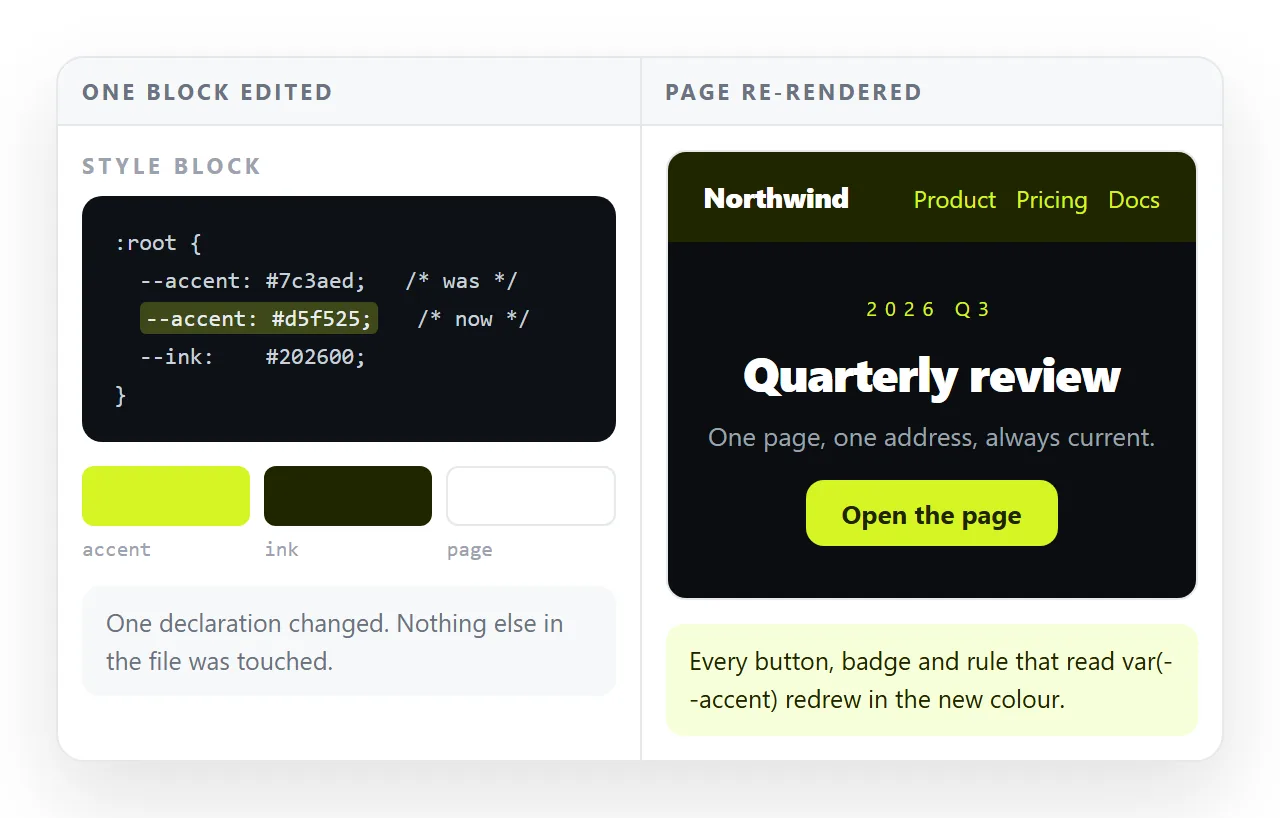
Then put the page at an address and keep editing it there. Pages that get corrected over time stop looking generated on their own, because the history the markup was missing starts to accumulate.