These tools do one thing well and one thing badly, and the badly one is what they are sold on.
What they catch
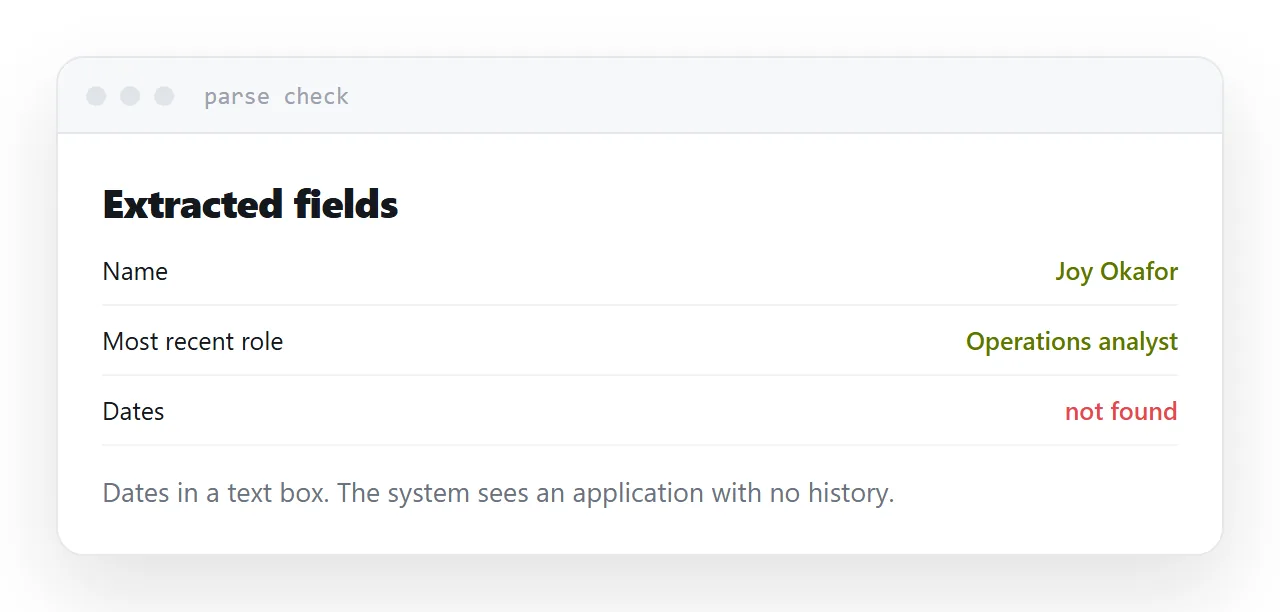
Parsing failures. An applicant tracking system reads the file and extracts fields. If your dates are in a text box, your name is in a header, or the layout is two columns, the extraction fails and the application is effectively blank.
That is a mechanical problem with a mechanical fix, and a parse check finds it in seconds. It is the single most valuable thing these tools do.
Missing basics. No dates, inconsistent formatting, contact details absent.
Keyword gaps against a specific job description. Useful when you paste the actual posting. The tool tells you the posting says stakeholder management four times and your document says it never.
| A tool can check | A tool cannot judge | |
|---|---|---|
| Does it parse | Yes | |
| Are dates present | Yes | |
| Keyword overlap with a posting | Yes | |
| Which experience matters here | No | |
| What to cut | No | |
| Whether the first ten lines land | No |
What they cannot do
A score out of a hundred, with no job attached, is a claim about a document in the abstract. There is no abstract. A resume is good or bad relative to one role.
The work that changes outcomes is judgement: which three things go first, what gets cut, how to describe a role in the language this industry uses. No score supplies that, and optimising toward one frequently makes the document worse for a human reader.
Documents written to satisfy a scoring tool read like documents written to satisfy a scoring tool.
The privacy question
A resume carries your employment history, often your address, usually your phone number.
Uploading it sends all of that to a company you may not have evaluated, sometimes one whose business is recruitment data.
Use a service you can identify and would be comfortable having your details. Remove the phone number before uploading if you are unsure; a parse check does not need it.
Fix parsing first
If a tool reports a parsing problem, that is the finding worth acting on.
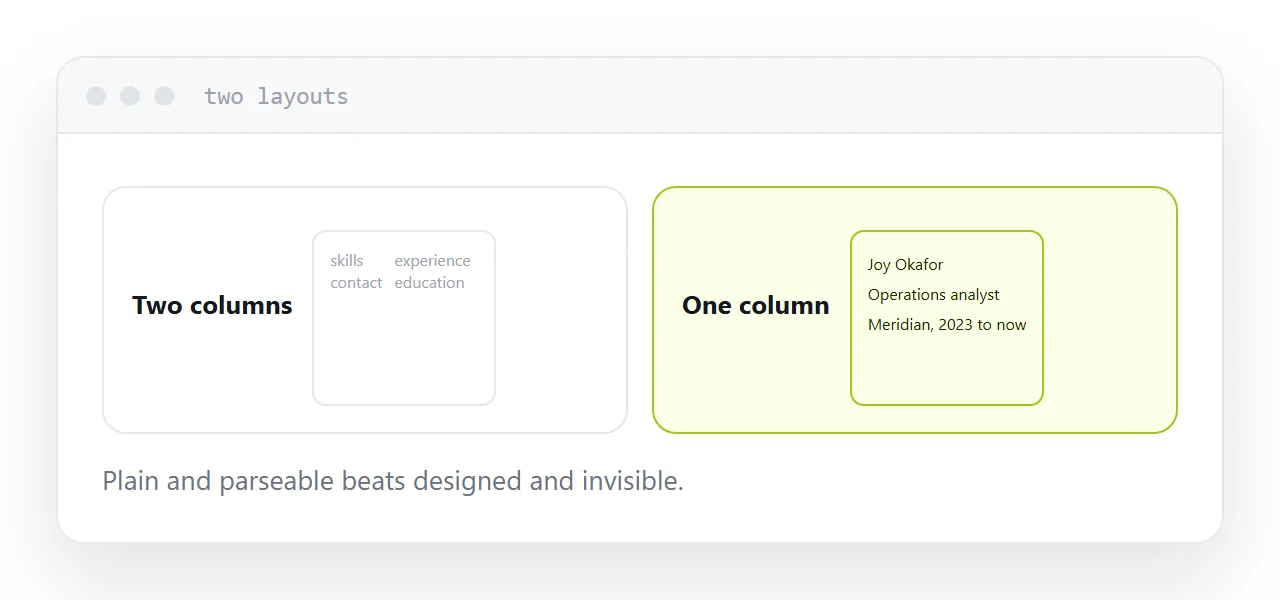
Single column. Dates as text in the body, not in headers or text boxes. Standard section names. No tables for layout. Contact details in the body.
Plain and parseable beats designed and invisible, and this is one of the few places where a tool's advice is straightforwardly correct.
Then do the judgement yourself
Reorder for the role. Cut what does not serve it. Write the first three lines for somebody deciding in twenty seconds.
That is half an hour and it moves outcomes more than any amount of score optimisation.
For the surrounding ground, see How to share your resume as a link and How to send your CV as a link.
Put it at an address
Use tools to confirm the document parses and to check keywords against a real posting, remove personal details before uploading, fix parsing problems first, and do the reordering yourself.
Then the file gets through the system and the words persuade the person.