A calendar invite link is an event published at an address with an .ics download, so anyone can add it to whatever calendar they use without a cross-organisation invite negotiating its way through two mail systems.
Invites work well inside an organisation and unreliably across a boundary.
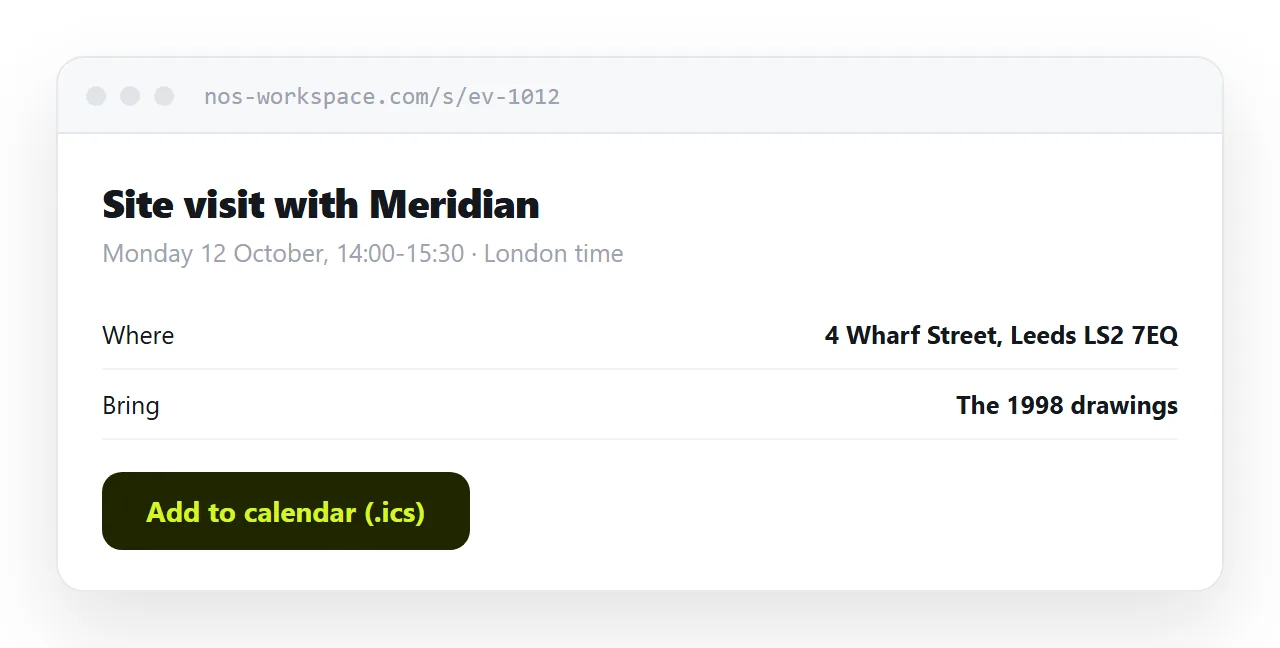
This guide covers why cross-organisation invites fail, what the .ics file does, time zones, and what a page cannot do.
Why invites fail externally
An invite is not a message, it is a scheduling transaction. Two calendar systems have to agree on an event, carry the accept or decline back, and keep both copies in step.
Inside one organisation that works. Across a boundary, several things go wrong quietly.
| What happens | Result for the recipient |
|---|---|
| Mail filter strips the attachment | No invite arrives |
| Their client does not parse it | An unopenable attachment |
| Accept does not route back | You never see the response |
| You move the meeting | Their copy does not update |
| Forwarded to a colleague | Often arrives as plain text |
The last two are the ones that cause missed meetings. A rescheduled invite that failed to propagate leaves two people holding different times, both convinced they are right.
The .ics download is the reliable part
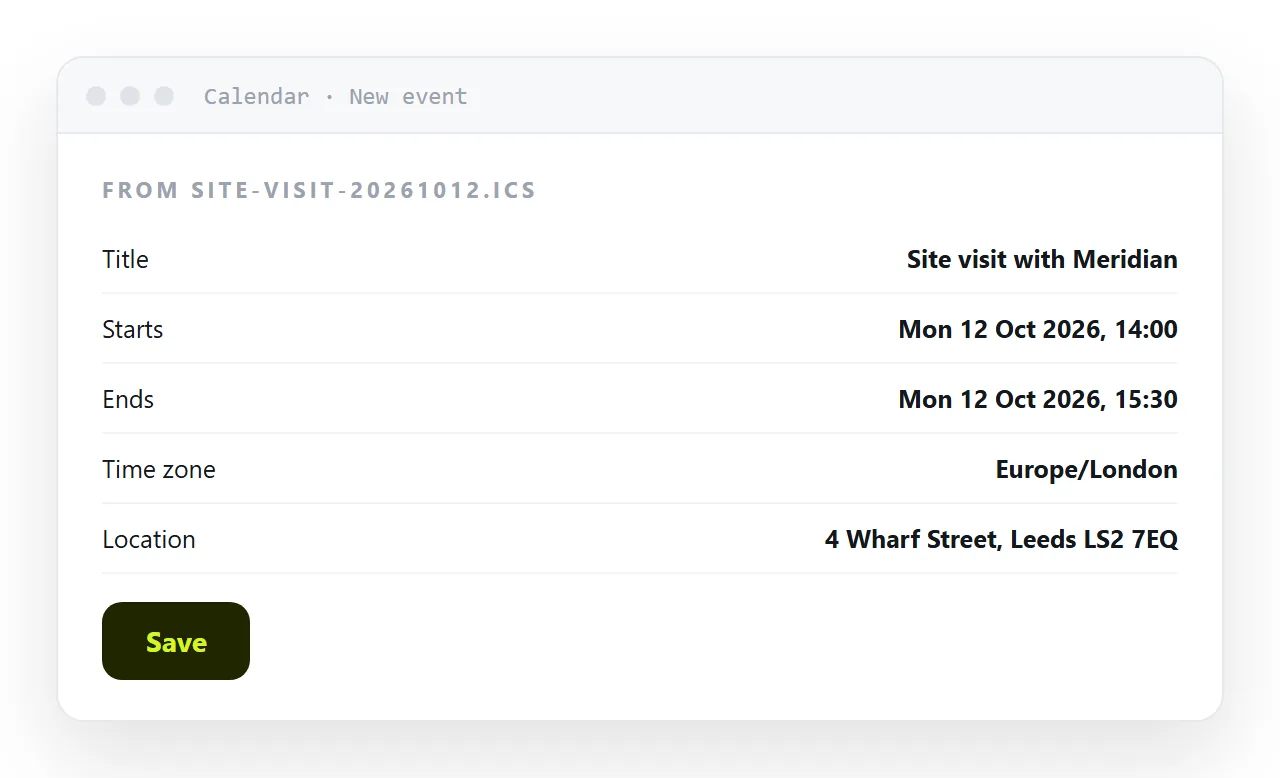
An .ics file is plain text describing an event. Every calendar application on every platform reads it, and has done for many years.
BEGIN:VCALENDAR
VERSION:2.0
PRODID:-//Trelis//Events//EN
BEGIN:VEVENT
UID:site-visit-20261012@trelis.example
DTSTAMP:20260918T090000Z
DTSTART;TZID=Europe/London:20261012T140000
DTEND;TZID=Europe/London:20261012T153000
SUMMARY:Site visit with Meridian
LOCATION:4 Wharf Street, Leeds LS2 7EQ
DESCRIPTION:Bring the 1998 drawings. Ask about the drainage route.
URL:https://nos-workspace.com/s/ev-1012
END:VEVENT
END:VCALENDAR
Two details matter. The TZID names the time zone, so the event lands at the right local time wherever it is added. And the URL points back at the page, so somebody who added the event months ago can find the details again.
Offer it as a plain download link on the page. That single button covers every calendar, including whatever the recipient uses that you have never heard of.
Say the time zone in words as well
Time zone errors are the most common failure in scheduling, and they are the easiest to prevent.
Write it out on the page: "Monday 12 October, 14:00-15:30 London time". Somebody in another country reads that and knows what to check. A bare "14:00" invites them to assume their own zone.
For anything with attendees across regions, listing two or three local equivalents is worth the space.
What belongs on the page
The page exists so somebody can answer their own questions without emailing you.
- What it is, in a line. A forwarded invite has no context.
- When, with the zone named and the duration stated.
- Where, as a full address, linked to a map if it is a physical place.
- How to join, if remote: the link, the dial-in number, and any code.
- Who is coming, if that helps people prepare.
- What to bring or read first.
What a page cannot do
Be clear about this, because the gap matters.
A page collects no responses. You get no attendee list, no accepts, no declines, and no automatic notification when someone cannot make it. For a meeting where knowing who is coming is the point, that is a real loss.
The practical arrangement is to use real invites for the people inside your organisation, where they work, and the page for external guests, tracking their responses however you normally would.
A page also cannot push an update. If the meeting moves, edit the page and tell people, because nobody's calendar will change on its own.
Embedding a whole calendar
Where you want to show a series rather than a single event, embedding a calendar view is a different job, covered in embedding Google Calendar in HTML.
For public events with many attendees, event link covers the wider page.
Put it at an address
Write the event on a page with the zone named, offer an .ics download, include the joining details, and create a share link.
Everyone adds it to whatever calendar they use, and nothing has to negotiate its way between two mail systems.