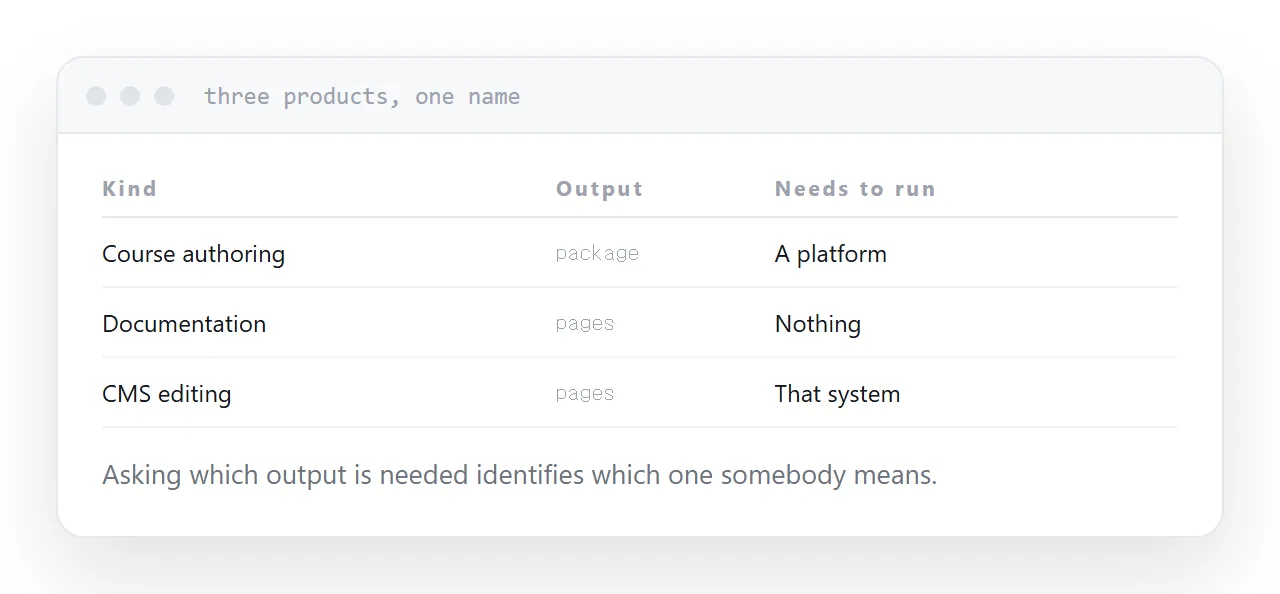
The phrase is used for three different categories of product with prices that differ by a factor of fifty. One question separates them.
The three things it means
Course authoring. Produces a package that runs inside a learning platform and reports completion back to it. Expensive, licensed per author, and the output only runs where a platform exists.
Documentation authoring. Produces web pages, usually from structured source. Ranges from free and text-based to substantial enterprise systems. The output runs anywhere.
Content editing in a management system. The editor inside a website product. Produces pages within that system.
Somebody saying authoring tool in a learning conversation means the first. In a technical writing conversation, the second. The word carries no information on its own.
| Course authoring | Documentation | CMS editing | |
|---|---|---|---|
| Output | Platform package | Pages | Pages in that system |
| Runs without a platform | No | Yes | In the system |
| Reports completion | Yes | No | No |
| Typical cost | High | Free to high | Part of the system |
| Lock-in | Source and output | Source only | Both |
The question that settles it
What output format does this need to produce.
A platform package, because completion has to be recorded against named learners for compliance. That is a real requirement and only course authoring tools meet it.
Pages, because people need to read something and nobody is auditing who finished it. Much cheaper options exist, including a text editor and a publishing step.
Asking that one question prevents the common outcome, which is buying a course authoring licence to produce reference material that nobody's completion is ever checked for.
Why the output matters more than the editor
Tools are evaluated on their editing experience, because that is what a demonstration shows.
The output format is what you live with. It determines where the content can run, who can maintain it, what happens when the licence lapses, and whether any of it is findable in search.
A package cannot be published at an address. A page can. That is a larger difference than any feature in an editor.
Keep the source outside
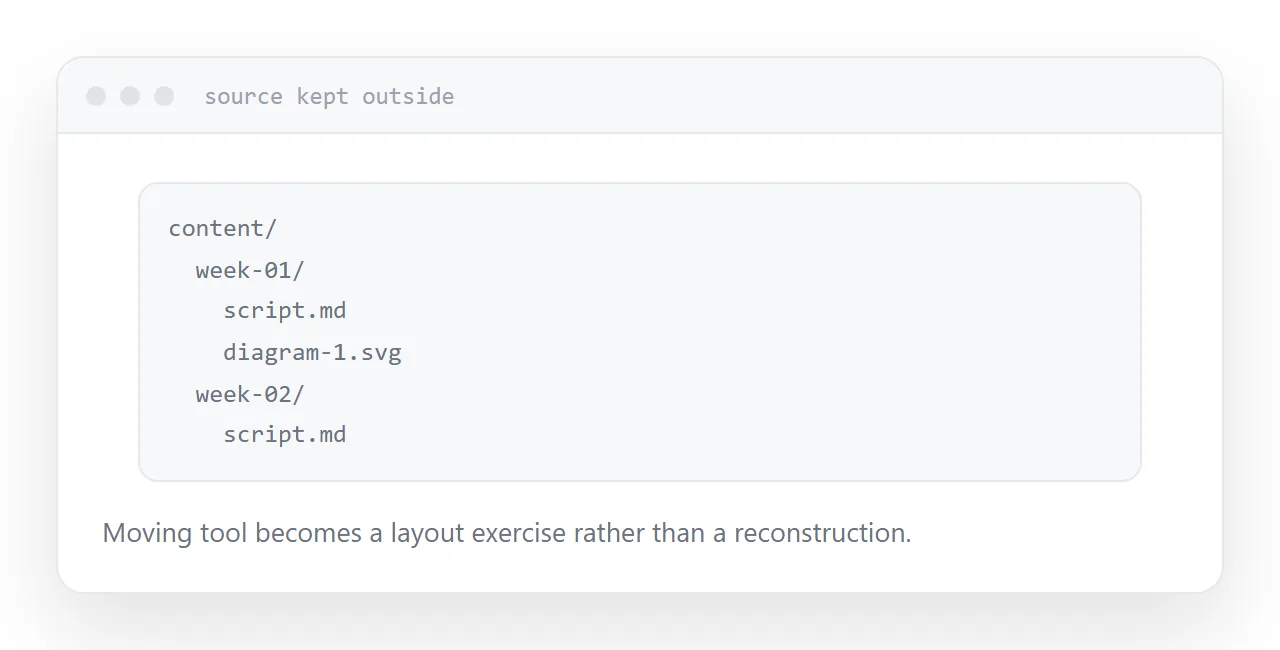
Whatever tool you choose, keep the actual content in a folder you own.
The script, the images, the exercises, the diagrams. Then moving to a different tool is a layout exercise rather than a reconstruction from published output.
Tools get discontinued, licences lapse, and organisations change direction. The content should survive all three.
Test the output early
Publish a two-page sample and put it through whatever will actually serve it, in the first week.
Packages behave differently across platforms. Documentation output looks different once served rather than previewed. Both produce expensive surprises at the end of a build and cheap ones at the start.
Two neighbouring cases are worth a look: Choosing an elearning authoring tool and What a learning management system actually does.
Put it at an address
Ask what output format is needed, buy a course authoring tool only when completion records are required, use simpler routes for pages, keep the source in your own folder, and test the output where it will run.
Then the tool is chosen on the thing that lasts.