Authoring tools are judged on their editing experience and the decision that matters is the output format.
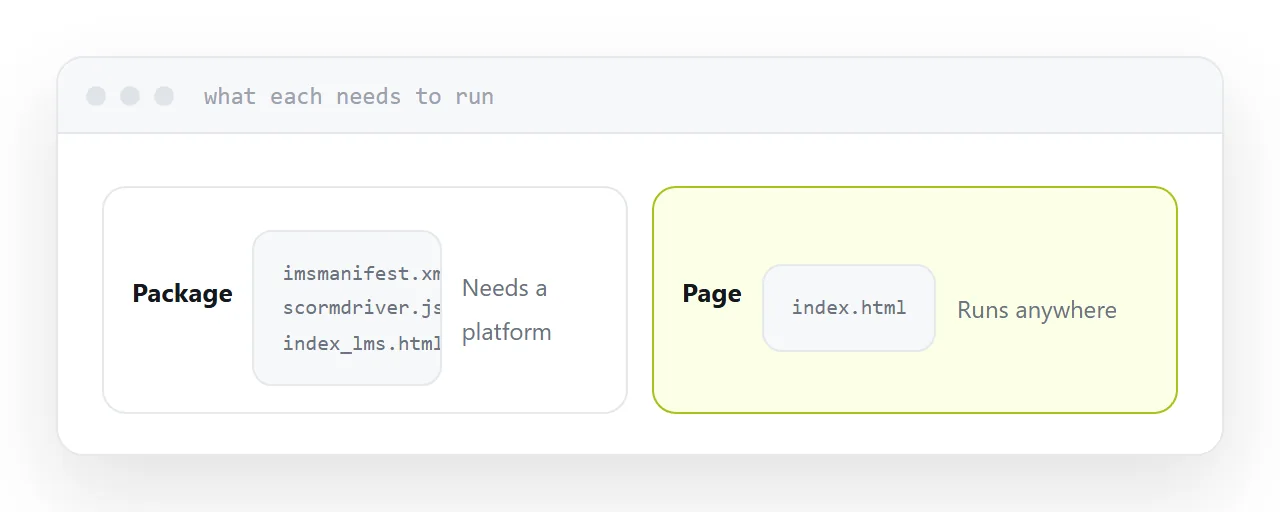
This guide covers what the package buys, what it locks up, and when a page is enough.
What the package format is for
Reporting. The package runs inside a platform and tells it who started, who finished, what they scored and when.
That is the entire reason the format exists, and it does it well. For compliance training, certification, or anything an auditor might ask about, it is the correct answer.
What it locks up
Where it can run. Without a platform to report to, the package frequently will not start, and where it does the tracking is meaningless. It is not a thing you can put at an address and send to somebody.
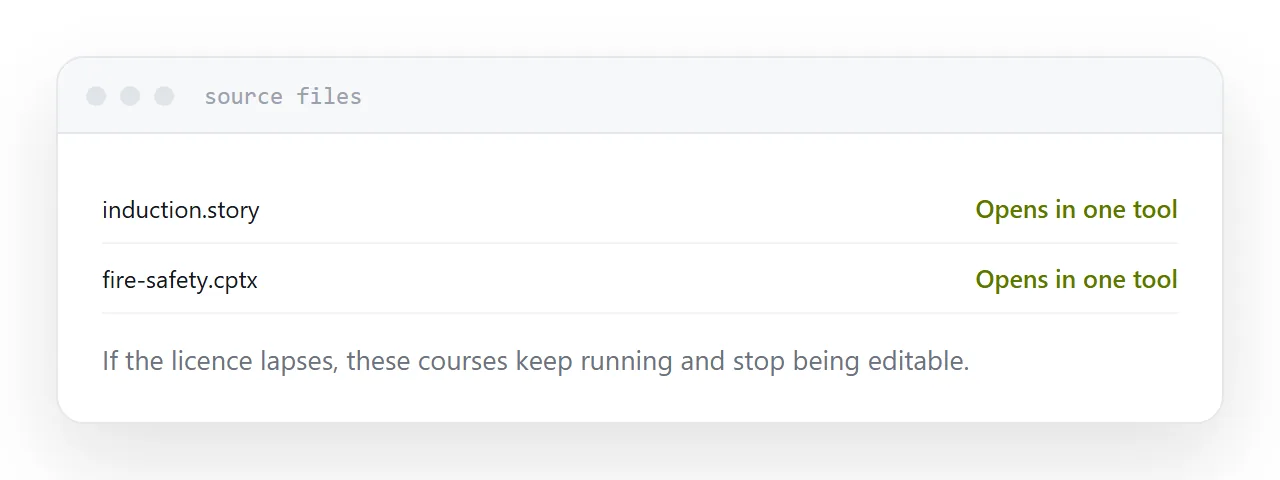
Who can edit it. Source files open only in the tool that made them. If the licence lapses or the product is discontinued, existing courses keep running and become uneditable.
What it costs to change. A typo in a published course means opening the tool, editing, republishing, and re-uploading to the platform.
| Authoring package | Page | |
|---|---|---|
| Reports completion | Yes | No |
| Runs without a platform | Usually not | Yes |
| Editable without the tool | No | Yes |
| Fixing a typo | Republish and re-upload | Edit |
| Findable in search | No | Yes |
The question that decides it
Does completion have to be recorded against a named person.
Yes. Regulated training, certification, anything with an audit requirement. Use a package and a platform. That is what they are for and the lock-in is the price of the record.
No. Internal enablement, customer education, onboarding, product training. Most courses are here, and the package format is buying a record nobody will ever look at.
For those, pages serve better: they run anywhere, are searchable, can be corrected in seconds, and do not expire with a licence.
Keep the content outside
Whatever tool you use, keep the actual content somewhere you own.
The script, the images, the exercises, in a folder. Then rebuilding in a different tool is a layout exercise rather than a reconstruction from screenshots.
This costs nothing during the build and it is the difference between changing tools being annoying and being a project.
Test in the real platform early
Packages behave differently across platforms. Tracking that works in one silently fails in another, and a quiz that scores correctly in preview reports nothing.
Publish a two-slide package and put it through the actual platform in the first week, not at the end. That is where the expensive surprises live.
For the surrounding ground, see What a learning management system actually does and How to host online training.
Put it at an address
Ask whether completion must be recorded. If not, publish pages. Check what happens when the licence lapses, keep the content in your own folder, and test the package in the real platform early.
Then the output format is a decision rather than a default.