Three routes exist and they differ in two currencies: what they take in commission, and what they take in customer relationship. The second one compounds.
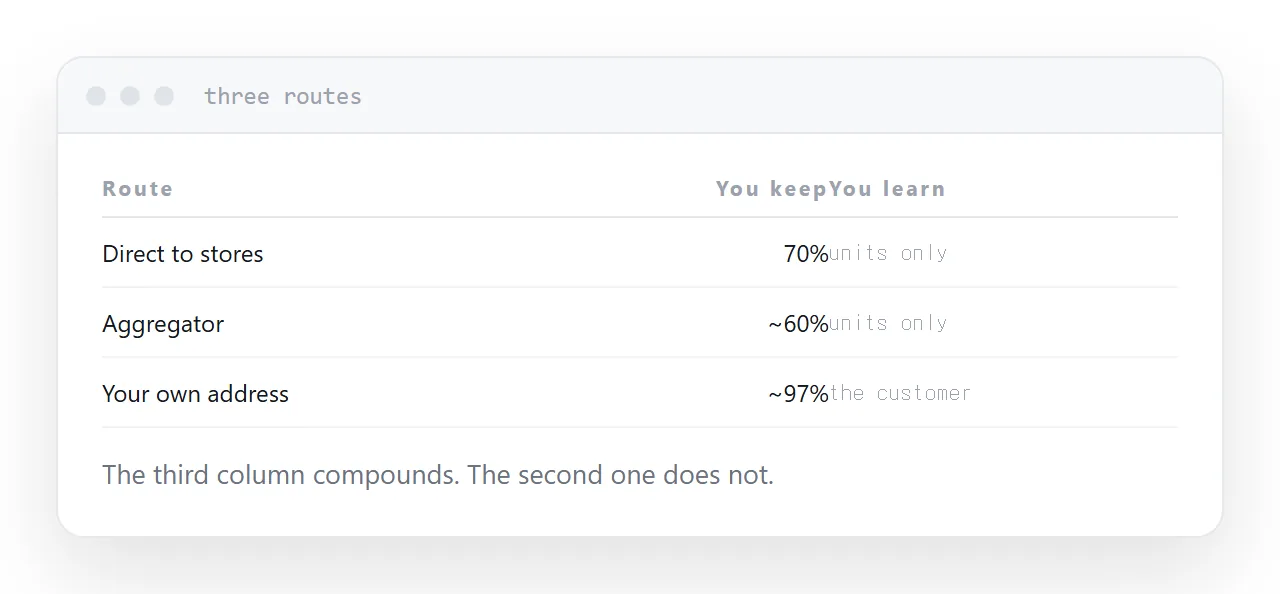
The three routes
Direct to each store. Separate account, separate metadata, separate royalty statement per store. Highest share, most administration.
An aggregator. One upload, one metadata form, distribution to everything. Takes a cut on top of the store's, and removes a real amount of work.
Selling from your own address. Payment processor fee only, and you learn who bought it.
| Direct to stores | Aggregator | Your own address | |
|---|---|---|---|
| Commission | Store only | Store plus theirs | Payment fee only |
| Admin per store | Real | None | None |
| Reach | The stores you choose | Everywhere | Only your audience |
| You learn who bought it | No | No | Yes |
| Setup effort | High | Low | Moderate |
Exclusivity is the real decision
One store offers a higher royalty rate and promotional programmes in exchange for selling nowhere else.
That is a genuine trade and it is the largest decision in this area. It is also the least reversible: the term is fixed, and while it runs you cannot list anywhere.
The arithmetic depends on where your readers are. If most of your audience is already on that store, the higher rate and the promotional access may be worth more than the sales you forgo. If your readers are spread, it is not.
Decide this before anything else, because it constrains every other choice.
Aggregators, honestly
For a first book, an aggregator saves a genuine amount of work. Six store accounts, six metadata forms, six sets of formatting requirements, six royalty statements.
The extra cut buys that away.
Once you are publishing regularly, look at where the sales actually come from. Usually two or three stores account for nearly all of it, and going direct to those while leaving the aggregator to handle the long tail recovers most of the difference.
Why direct matters more than the margin
Every store route returns a number. Units sold, revenue, and nothing else.
You do not learn who bought the book. You cannot tell them the next one exists. Each launch starts from whatever the store's ranking gives you that week.
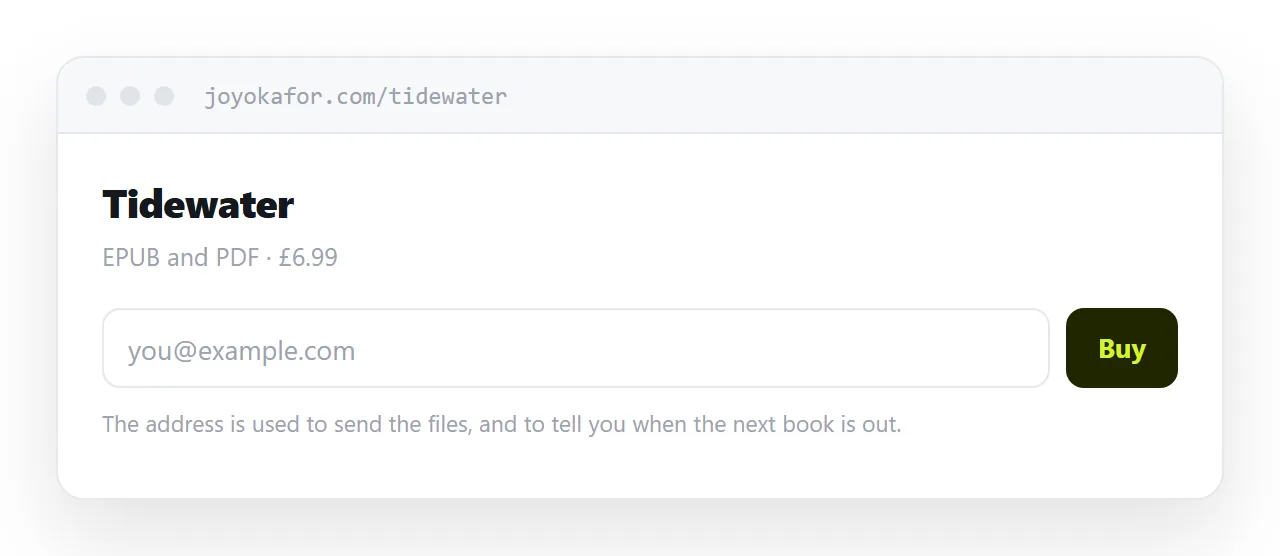
Selling direct returns a customer. Even at a small share of total sales, those readers are the ones who buy in the first week of the next book, which is what ranking responds to.
That is the argument for direct, and it is not really about the commission.
What survives every decision
A book page at your own address, with the sample, the buying links and one signup field.
Platforms change terms, close, and reorganise. That page keeps working, keeps accumulating search position, and keeps collecting readers you can reach.
If this is near what you are doing, How to publish an ebook and How to publish a book for free cover the cases on either side.
Put it at an address
Decide exclusivity first, use an aggregator for a first book, go direct to what actually sells once you are publishing regularly, sell direct alongside, and keep a book page at your own address.
Then the platform choice is reversible and the audience is yours.