Serving web pages directly from a storage drive worked for years, then was withdrawn. The guides describing it remain, which is why people keep trying.
What happens now
Upload a page to a drive, set sharing to anyone with the link, and open it.
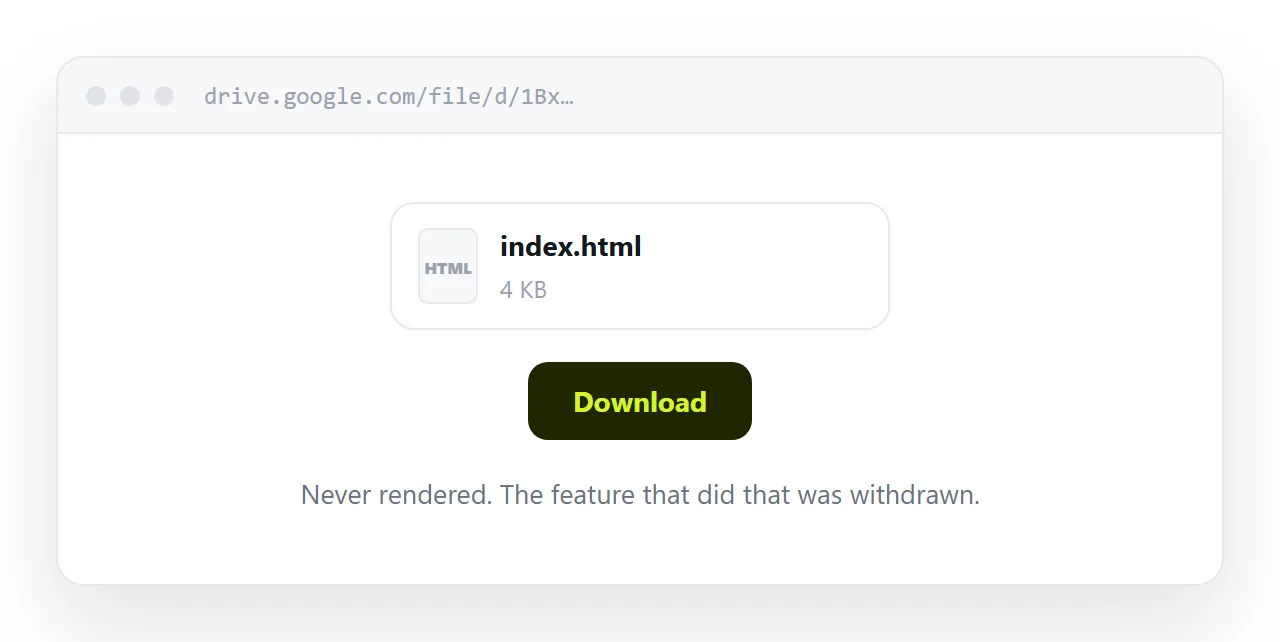
The file downloads, or a preview screen appears with a download button. The markup is never rendered.
That is by design. A drive is storage, and the feature that made it serve pages was removed because serving arbitrary user files as pages from a shared domain is a security problem.
| Drive | Static host | |
|---|---|---|
| Renders the page | No | Yes |
| Address | Long identifier | Short and clean |
| Custom domain | No | Yes |
| Relative paths between pages | No | Yes |
| Good for storage | Yes | No |
Why the guides persist
They were written when it worked, ranked well, and were never updated.
This is one of the more durable pieces of stale advice on the web, and it costs people an afternoon each time. If a guide describes this, check when it was written.
The proxy services
Services exist that take a drive file identifier and render it.
They work, and they add a third party between your page and its readers, for something a static host does directly, faster, with a better address and no dependency.
If one of those services closes, every link you published through it dies. That is a real cost for no benefit.
Even when it worked, the address was bad
Worth noting because it affects the alternatives too.
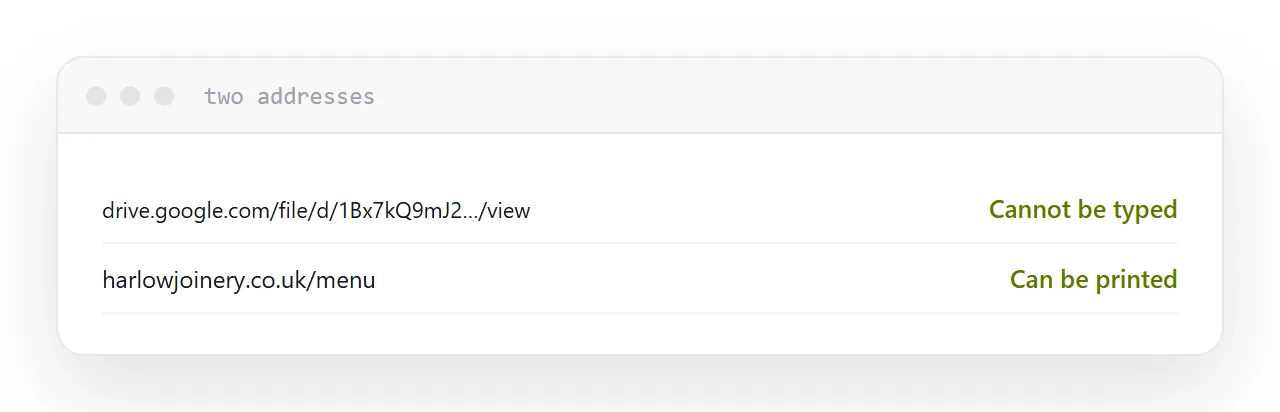
A drive address is a long opaque identifier. It cannot be typed, cannot be read aloud, cannot be printed on anything, and carries no information about what it leads to.
Relative links between pages do not resolve, so a small site with several pages never worked properly even when single pages did.
What to do instead
Publish the file on anything that serves static files.
The file works unchanged. The address is short and can be printed. Relative paths between pages resolve. Custom domains work.
Keep the drive for what it is genuinely good at, which is storing files you need to find again.
Put your own domain in front
Whatever host you choose, this is the part that lasts.
The page can be moved between hosts in an afternoon. The address cannot, once it is in messages and printed material. Setting up a domain at the start removes the question permanently.
For the surrounding ground, see A Google Drive alternative for sharing and Free HTML file hosting, compared.
Put it at an address
Stop following guides written before the feature was withdrawn, keep the drive for storage, publish the file on a static host, avoid proxy services, and own the domain.
Then the page renders, and the address is one you can say out loud.