Generated prose is fluent and average, and average is the problem. Used on the right passes it is a genuine help.
Where it helps
Unsticking. You know the scene ends with her leaving and not how she gets there. Four suggested routes, all wrong, and the fourth shows you what you actually wanted.
Options to reject. Ten possible opening lines. You will use none of them and you will know your opening line better afterwards.
Continuity. Paste four thousand words and ask what contradicts itself. Models are good at this and writers are bad at it on their own work.
Reader confusion. Ask what is unclear on a first reading. The answers are blunt and frequently correct about a passage you had stopped seeing.
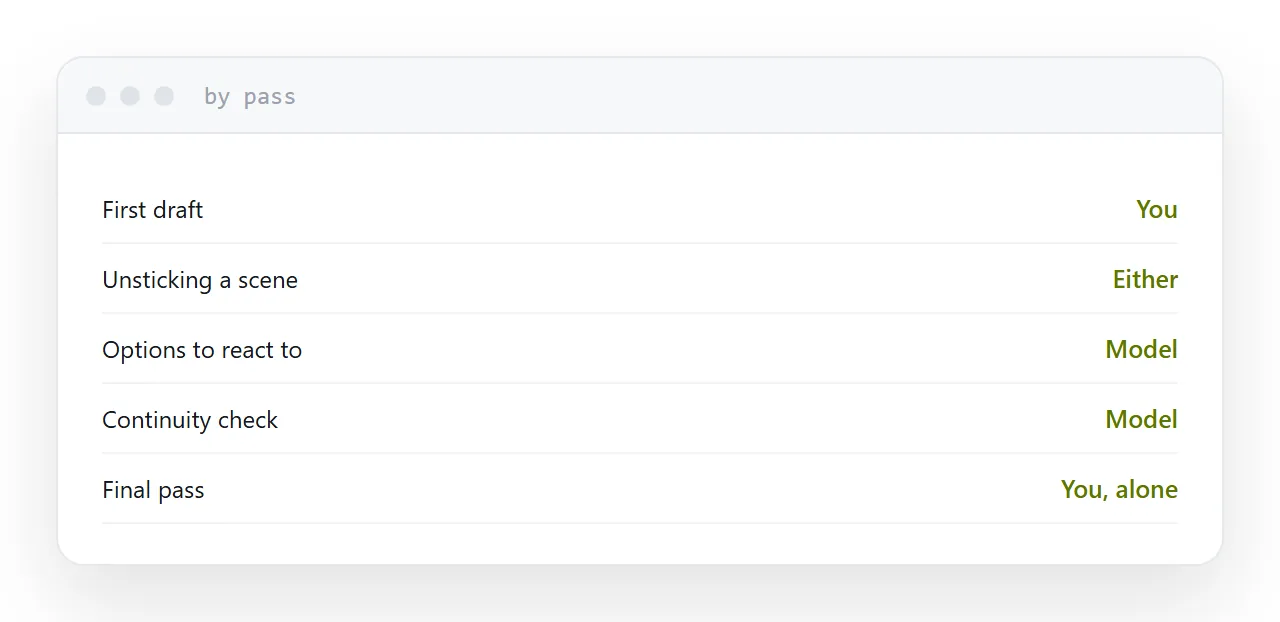
| Pass | Who does it |
|---|---|
| First draft | You |
| Unsticking a scene | Either |
| Options to react to | Model |
| Continuity check | Model |
| Line editing | You |
| Final pass | You, alone |
Where it flattens
Specific detail.
A story lives on the exact thing: the wrong brand of cigarette, the particular sound the door made, the phrase somebody used that nobody else would. Generation reaches for the nearby average, and the average detail is the one a reader forgets.
Ask it to rewrite a paragraph and you will usually get something smoother and less memorable. That trade is worth noticing each time rather than accepting by default.
Voice goes the same way. A model has read everything and sounds like the middle of it.
The last pass is yours
Whatever happened earlier, read the whole thing through and change it yourself at the end.
That pass is where a story becomes one person's rather than nobody's. Handing it over is how competent, forgettable pieces get finished.
Disclosure
Competitions and publishers are adding questions about this, and the terms vary from prohibited to permitted with disclosure.
Read them before entering. The answer should be honest, and if the honest answer would disqualify the piece, that is useful information about the piece rather than about the rules.
Publishing it
A finished short story needs a reading page and nothing else.
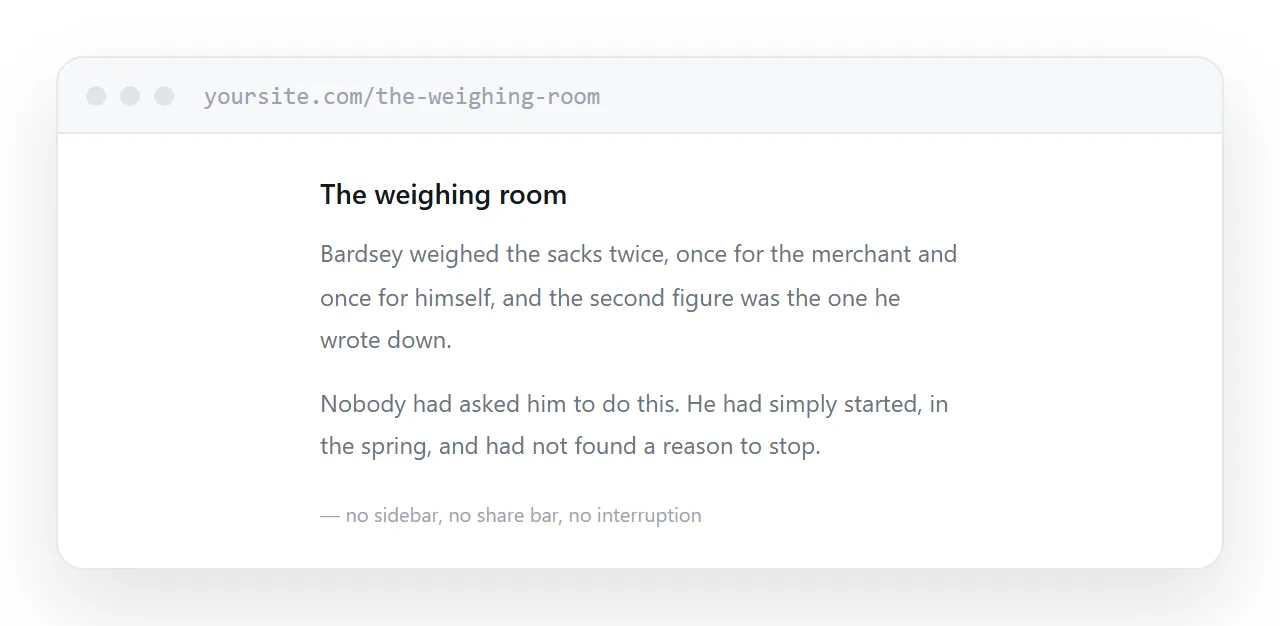
A column of text sixty to seventy-five characters wide, generous line spacing, dark grey on off-white, no sidebar, no share bar, no interruption. Your name and one line of contact at the end.
At your own address, not inside a platform whose interface surrounds your work and whose terms can change. One link, which you can send anywhere and which keeps working.
Two neighbouring cases are worth a look: How to publish a short story online and How to publish a novel online.
Put it at an address
Use it to unstick rather than to draft, ask for options you will reject, keep every specific detail yours, make the last pass alone, and publish the finished piece at an address you control.