A job link is a role published at one address, so every board, message and referral points at the same current advert and it survives after the listings expire.
Candidates read adverts fast and leave quickly. The structure matters more than the prose.
This guide covers the order things should appear in, the salary question, why requirement lists cost you candidates, and what to do when the role closes.
Four things, in the first screen
| What the candidate wants | Where most adverts put it |
|---|---|
| What the job involves | Third section |
| Whether they can do it | A twelve-item list |
| What it pays | Absent |
| Where, or whether remote | Near the bottom |
Reverse it.
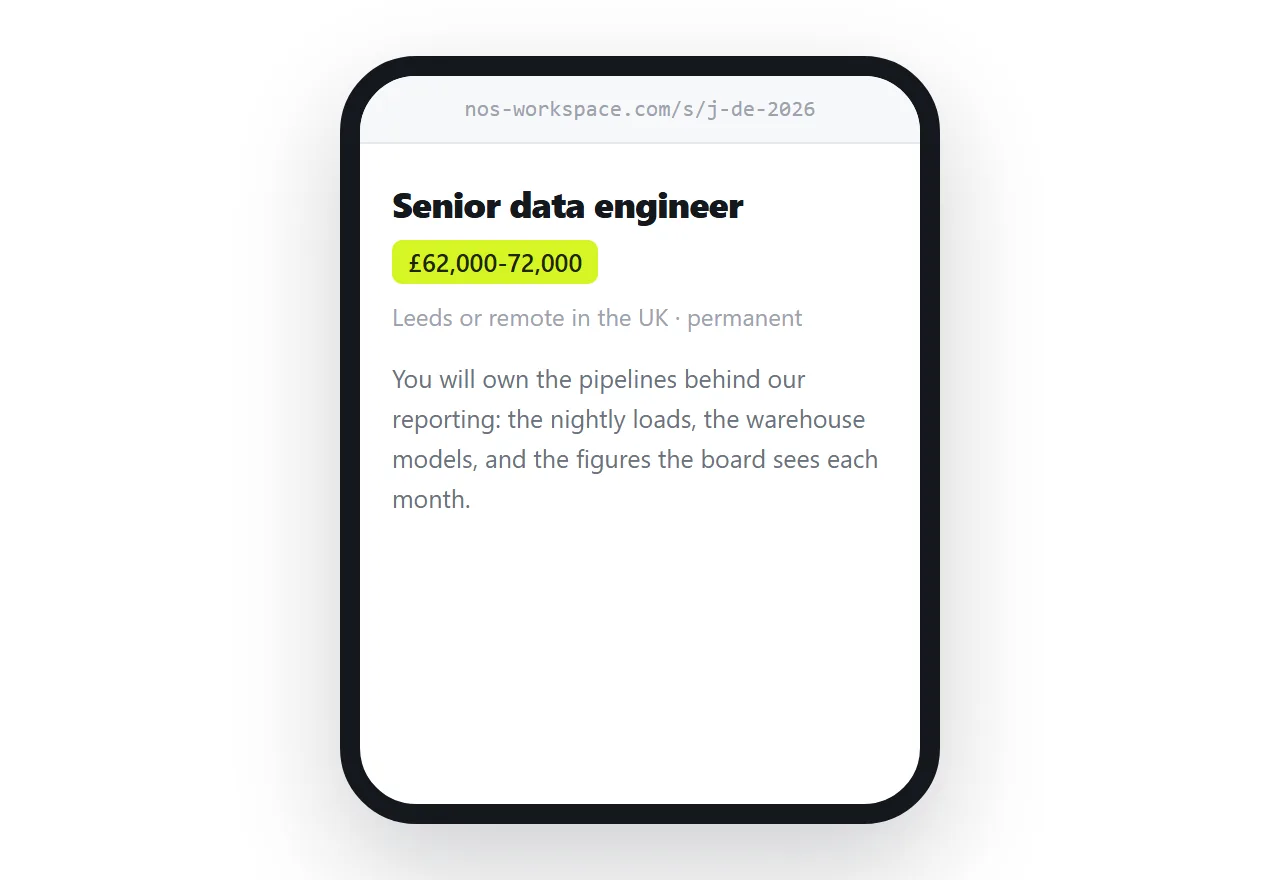
<header class="role">
<h1>Senior data engineer</h1>
<p class="terms">£62,000-72,000 · Leeds or remote in the UK · permanent</p>
<p class="what">You will own the pipelines behind our reporting: the nightly
loads, the warehouse models, and the figures the board sees each month.</p>
</header>
Anyone scanning has enough to decide. The company paragraph can follow, and it will be read by the people who got past this point, which is the right audience for it.
Publish the salary
Some jurisdictions now require it, and independently of the law it is the single change that most improves the applications you get.
A candidate who cannot see the range either skips the advert or applies and asks at the first call, which wastes both of you an hour if the answer is wrong. "Competitive" is read as "below market", because that is usually what it means.
Publish the range and say what moves a candidate within it. If you cannot publish a range, publish the band and the review point. Something is better than nothing.
The requirements list is costing you candidates
Long lists filter in exactly the wrong direction.
A candidate who meets nine of twelve items and reads the list as a specification often does not apply. The ones who apply anyway are, on average, less careful readers rather than stronger engineers. Several studies have found this pattern falls unevenly across groups, so a long list narrows your field in ways you did not intend.
Split it and keep it short.
- Required. Three or four things the job genuinely cannot be done without.
- Useful. A few more that would help, marked clearly as optional.
- Not required. Say explicitly where you will train, if that is true.
Three required items with a sentence saying you do not expect every candidate to have everything will get you more applications from people who can do the job.

Say what happens after they apply
The last screen loses applications.
Tell them how to apply, what to send, who reads it, how long it takes, and what the stages are. A candidate who knows there are two interviews and a task, and that they will hear within a week, applies. One facing a form and silence often does not finish.
If you use an applicant tracking system, say so, and keep the page as the readable advert that links to it. Candidates want to read on a page and are willing to apply in a system.
One page, every channel
Post to whatever boards you use, and point each listing at the page.
Boards truncate, reformat, and expire. Referrals get forwarded as a link and lose their context. Social posts have character limits. The page is the version you control and the one that is current.
When something changes, and it usually does, change the page rather than editing five listings.
After it closes
Do not delete it.
Mark it closed with the date, keep the details readable, and say whether you would welcome speculative applications for similar roles. Candidates find adverts long after they lapse, and a dead link tells them nothing while a closed advert tells them you were hiring for this and might again.
Writing the description itself is covered in HTML for job descriptions.
Put it at an address
Lead with the role, publish the salary, cut the requirements to what is required, say what happens next, and create a share link.
Then point every board and every referral at that one address.