A case study link is a customer story published at an address rather than attached, so it forwards inside a buying organisation as one version and can be strengthened as results come in.
Case studies fail in two ordinary ways: nobody finishes them, and the version being discussed is not the one you sent.
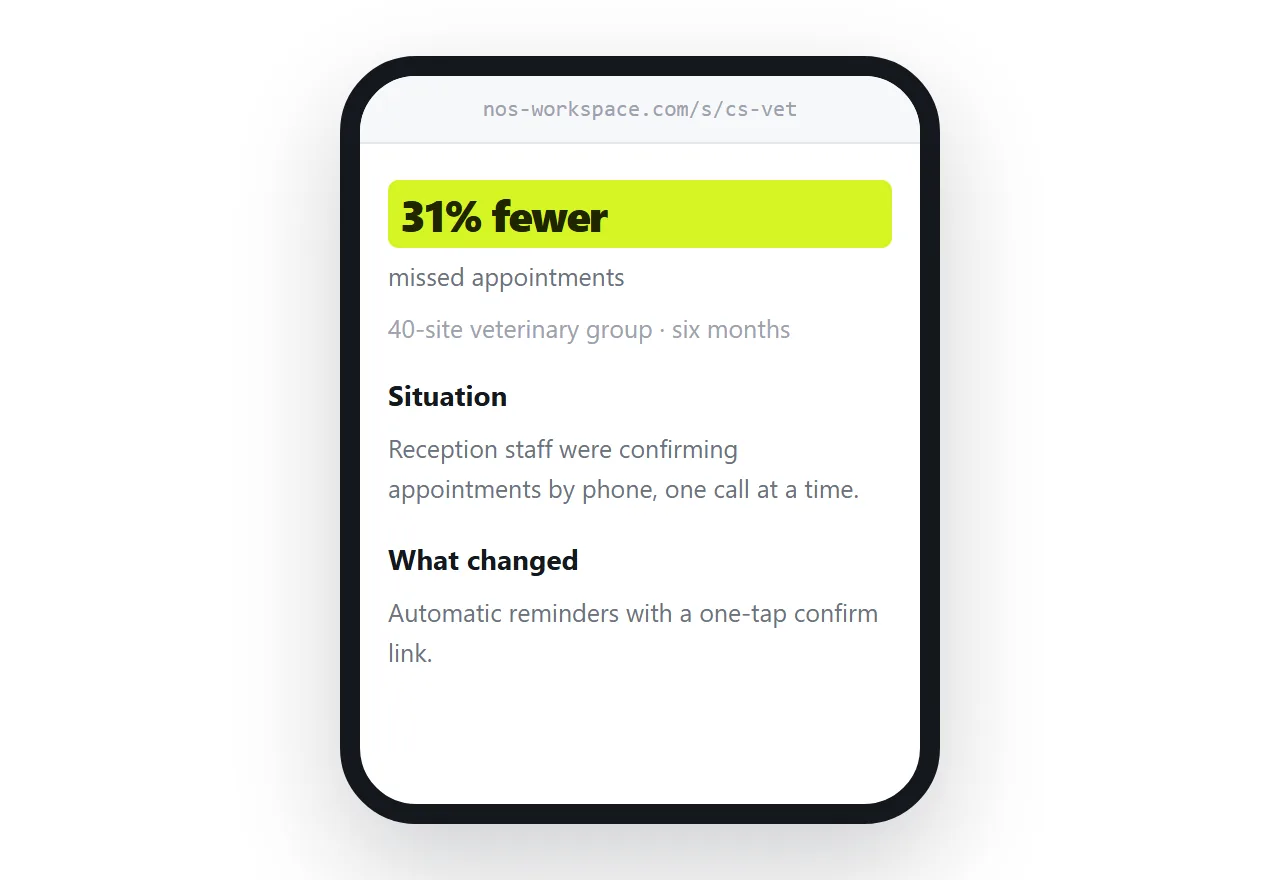
This guide covers putting the result first, describing a client who cannot be named, keeping claims checkable, and why updating matters more than it sounds.
The result goes first
Case studies are conventionally written as narratives: background, challenge, solution, outcome. That is the order events happened in and the wrong order to present them.
A buyer is deciding whether to keep reading. Give them the outcome immediately, then earn it.
<header class="result">
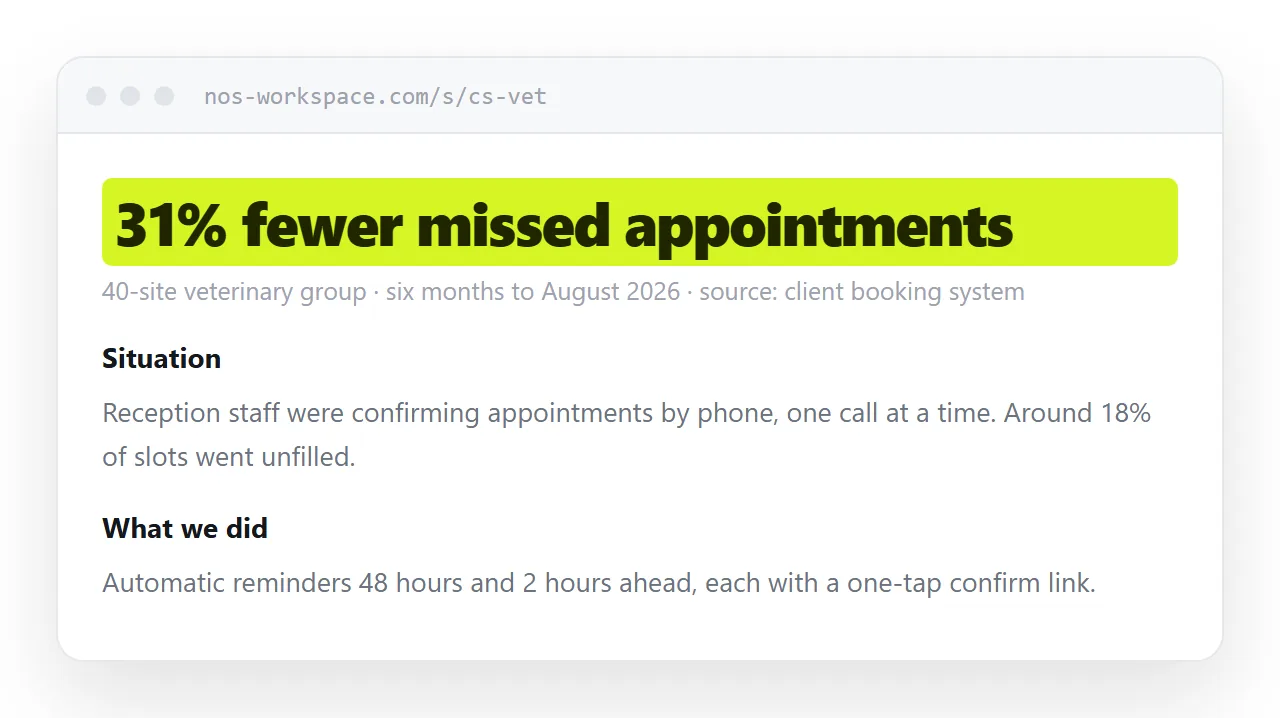
  <p class="figure">31% fewer missed appointments</p>
  <p class="who">40-site veterinary group · six months</p>
</header>
The narrative still follows. It is just no longer the thing standing between the reader and the reason to care.
Make the client recognisable
The reader is asking one question throughout: is this company like mine?
Sector and scale answer it. So does the specific shape of the problem, which is often more recognisable than the industry.
| Too vague | Usable |
|---|---|
| A large retailer | A 60-store homeware chain |
| A healthcare provider | A 40-site veterinary group |
| Improved efficiency | 31% fewer missed appointments |
| Significant savings | £74,000 a year in staff time |
If the client cannot be named, the precision has to come from everything else. An anonymous study with exact figures and a specific situation is credible. An anonymous study with rounded percentages is not.
Separate what you did from what changed
Readers are sceptical of case studies because so many blur the two, implying causation where there was coincidence.
Keeping them in separate sections helps, and so does naming what else was happening. A study that says "we also moved premises that quarter, so some of this is not us" is more persuasive than one that claims everything.
Where you have it, give the measure before and after with the period attached. Where you do not, say what you are estimating and on what basis.
Numbers have to be checkable
Every figure needs a measure, a period, and a source.
- Measure. What exactly was counted. "Missed appointments" not "efficiency".
- Period. Over what span, and compared against what earlier span.
- Source. Their system, your reporting, or a survey. Say which.
- Scope. All sites or a pilot. Buyers assume the best case unless told.
This discipline costs a sentence each and it is the difference between a study a procurement team can use internally and one they cannot.
Built for the forward
Your contact is rarely the decision maker. They are the person who has to convince the decision maker, and the case study is the artefact they use to do it.
That has design consequences. Headings should let a skimmer find the part they were asked to check. The result should survive being read alone. And the contact details should be on the page, because the person who acts on it may never have met you.
An attachment forwarded three times becomes three files. When you improve the study, none of them change. A link forwarded three times is one address that improves for everyone.
Updating is an advantage, not an afterthought
Most results keep moving after the write-up. Six months of data becomes eighteen, and the number usually gets better.
With a file, that improvement is invisible unless you rebuild and resend, which nobody does. With a page, you change the figure and date the revision, and every buyer holding the link now sees the stronger version.
Note the revision plainly: "Updated 4 March 2026: figure now covers eighteen months." That is more credible than a silently improved number.
Put it at an address
Write the study as a page, paste it into a document, create a share link, and send that link rather than an attachment.
It opens on a phone, forwards as one version, and gets stronger as the results do.