The exchange is explicit: something useful for permission to contact somebody. It fails when the thing offered is worth less than the permission.
Why most do not work
Because they are the brochure with a cover page.
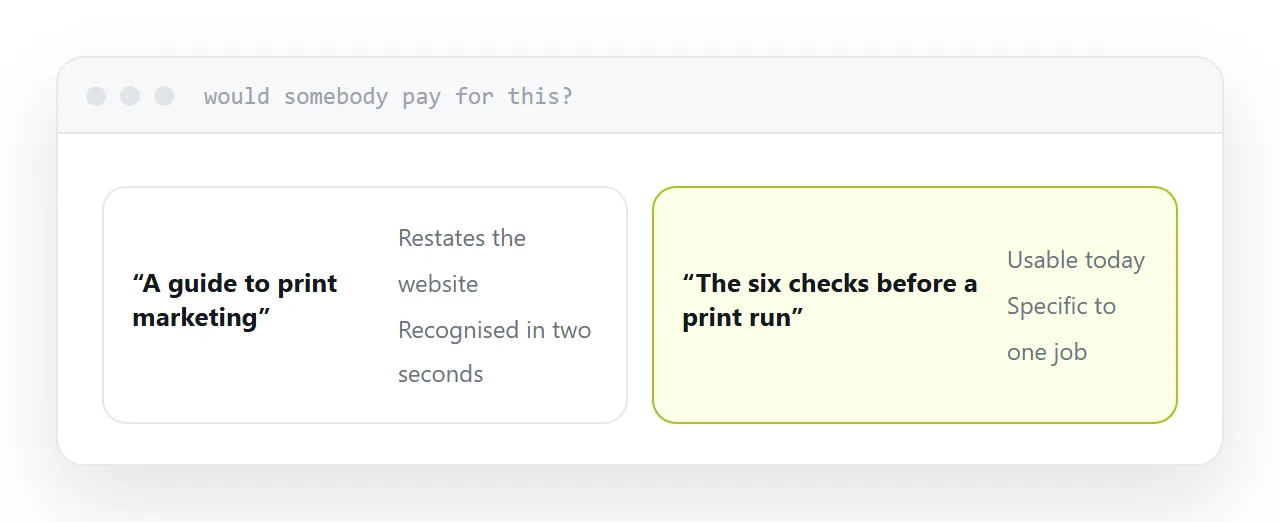
People have given their address away enough times to know what usually arrives. A general document restating what the website says is recognised in about two seconds, and the form is abandoned.
The test is simple: would somebody pay a small amount for this if it were sold? If not, it is not worth an address either.
| Offer | Usually works |
|---|---|
| A template they can use today | Yes |
| A calculator for their numbers | Yes |
| A checklist for a specific job | Yes |
| Real benchmark figures | Yes |
| A general guide to the industry | No |
| A brochure with a cover | No |
Specific beats comprehensive
"A guide to marketing" is worth nothing. "The six checks before a print run, with the two that catch most errors" is worth an address.
Narrow offers also attract the right people. A general guide brings everybody, most of whom will never buy anything, and you have paid for a list of them.
Write for one situation, in detail, and accept the smaller audience.
Deliver it as a page
The reflex is a downloadable document. It is usually the wrong format.
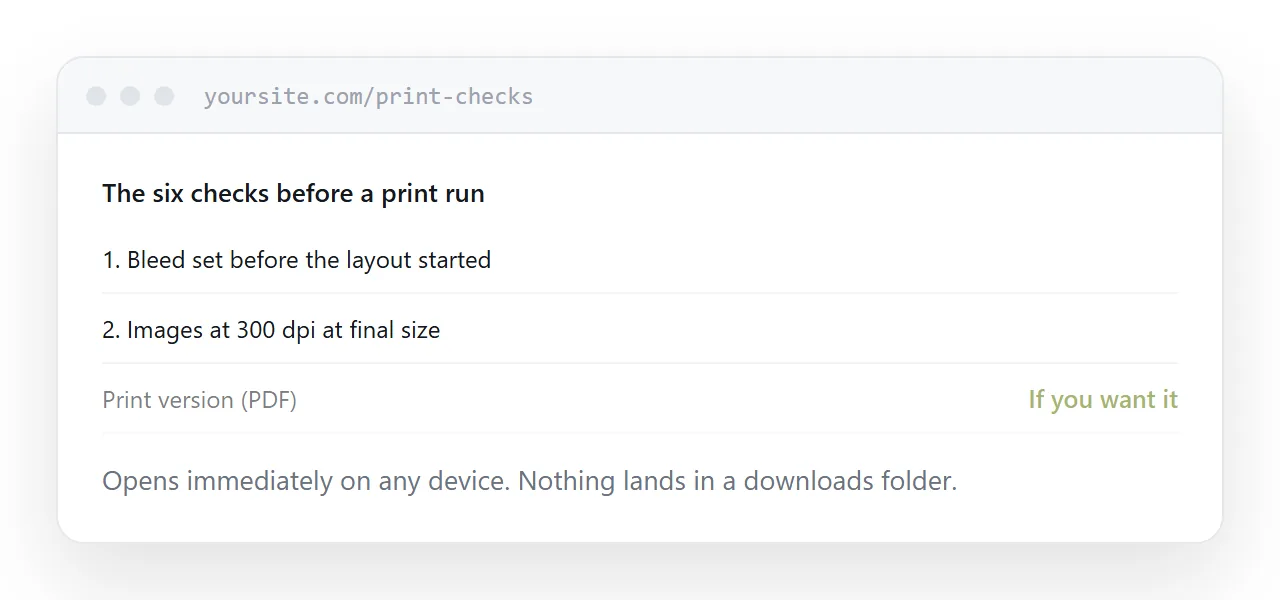
A download lands in a folder, and on a phone a large share are never opened at all. A page opens immediately, reads at any width, and can be corrected after it has been sent to a thousand people.
If somebody wants a file to print or file, link it from the page. The page is what they get.
One field
Ask for the email address. Nothing else.
Every additional field reduces submissions measurably, and the extra fields are usually collected out of habit rather than because anybody uses them. Company size and job title can be asked in the reply, when there is a conversation to justify them.
Say plainly what you will send and how often. The specific promise is more persuasive than any reassurance about privacy.
What happens next
Send something within a day, and make the first message useful rather than a sales approach.
A list collected and left alone decays quickly. By the time somebody eventually writes to it, nobody remembers signing up and the message reads as unsolicited.
If you do not have a plan for what you will send, do not collect addresses. Publish the useful thing openly instead, which builds more than an unused list does.
Closely related: How to make an email capture page, and How to collect email addresses for the adjacent problem.
Put it at an address
Make it useful on its own, keep it specific, deliver it as a page rather than a download, ask for one field, and follow up within a day or do not collect the address at all.