These two are compared constantly and they are different businesses with a similar effect on your document: it ends up inside somebody else's product.
What each one is
A reading subscription. Readers pay for access to a library. There are browsing users, so a document can be found by somebody who was not sent it.
A publishing viewer. You upload, it renders with a page-turn, and you send the link. The readers are almost entirely people you sent.
That second point is the important one. If the readers are people you sent anyway, the platform is a wrapper you are paying for rather than distribution you are buying.
| Reading subscription | Publishing viewer | Your address | |
|---|---|---|---|
| Browsing audience | Some | Little | None |
| Their branding | Yes | Yes | No |
| Sign-up prompts | Common | Sometimes | No |
| Text searchable | Partly | Rarely | Yes |
| Address is yours | No | No | Yes |
| Survives the platform closing | No | No | Yes |
What the reader experiences
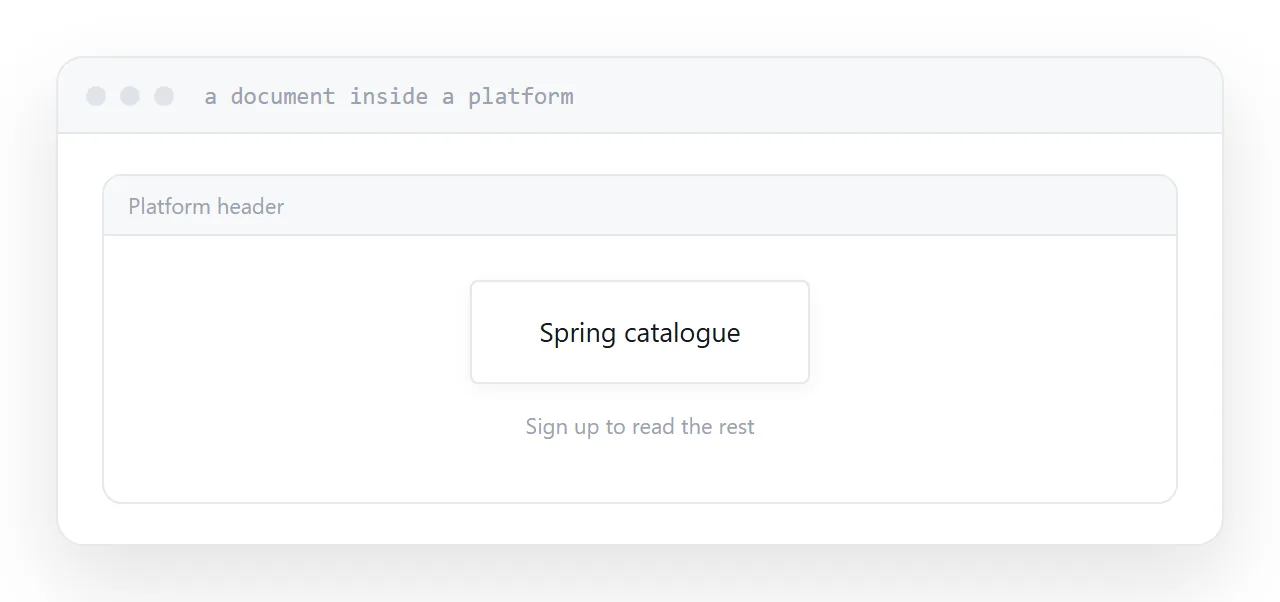
A header that is not yours. Viewer controls. Related documents from other people. Frequently a prompt to create an account or a limit on reading without one.
Your document is in the middle of all that. For a client reading a proposal, the impression is that you had nowhere to put it.
The search question
Page-turning viewers render documents as images. There is no text, so search engines find nothing in them.
For a catalogue, a brochure or anything you want discovered, that is disqualifying. The document exists and is invisible to the main way people find things.
A subscription library does index some text, which is part of the argument for it, and it indexes it on their domain rather than yours.
The address problem
Every link you publish points into their site.
A paywall, a redesign, an address scheme change or a closure takes your document with it, and all of those have happened in this category. There is no recovery, because the links are in other people's pages and in printed material.
An address you own has none of that exposure.
What to do
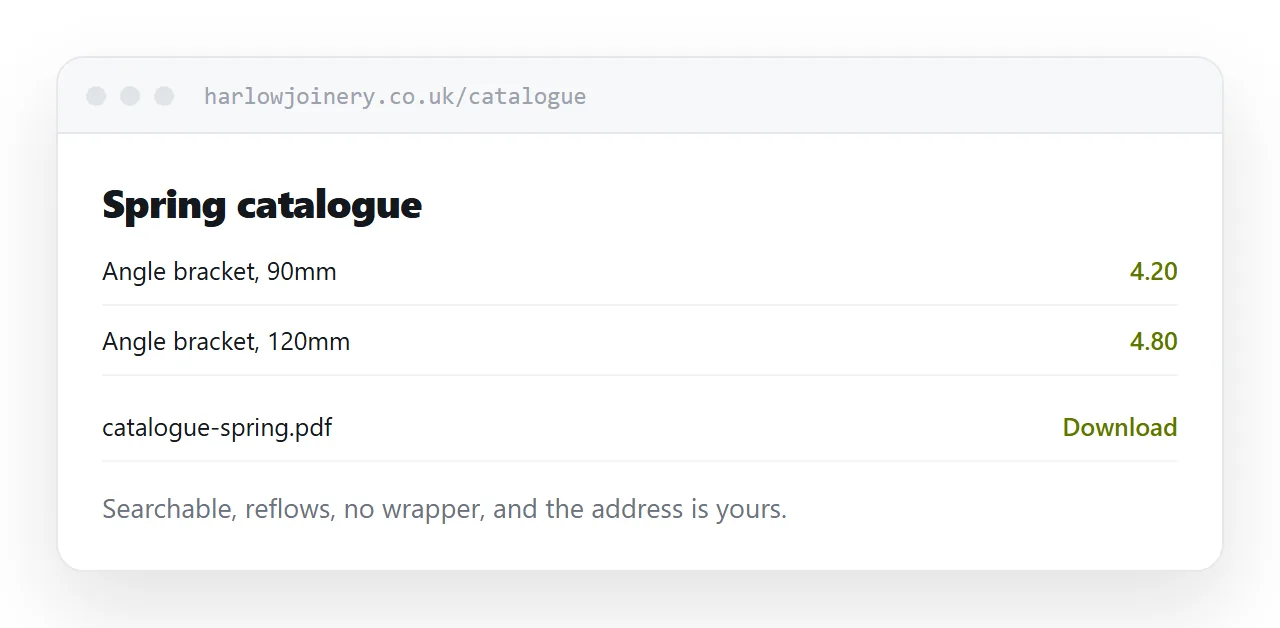
Put the content on a page at your own address, with the document downloadable underneath.
Searchable, reflows to a phone, no wrapper, no prompts, and the address is yours. Over a few months that usually outperforms a platform on discovery, because the content is at an address you control rather than inside somebody else's site.
If a platform genuinely has an audience you want, publish there as a secondary channel pointing back at your version.
Two neighbouring cases are worth a look: Choosing a document hosting alternative and PDF flipbooks, honestly.
Put it at an address
Ask whether you need their audience, look at what the reader sees before the document, check whether the text is searchable, keep your own address as canonical, and use a platform as a secondary channel if at all.
Then the reader sees your document rather than somebody else's product.