Document platforms host a file and wrap it in their product. Whether that is a good trade depends entirely on whether you need what the wrapper provides.
This guide covers what the wrapper costs, what it gives, and when to host it yourself.
What the wrapper costs
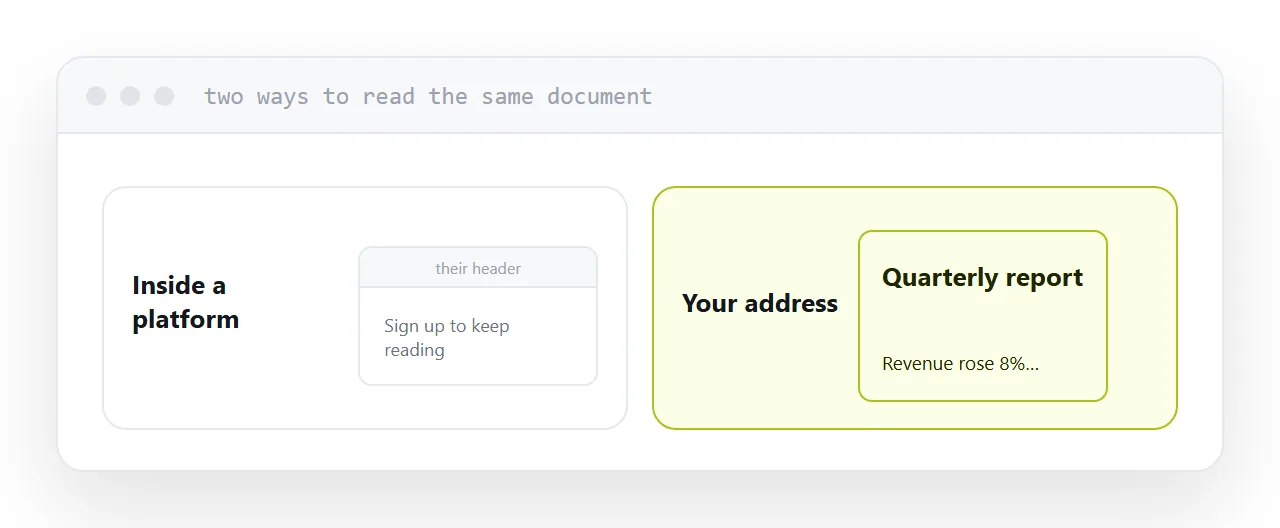
The reader taps your link and arrives at a platform.
Their header, their reader controls, their related-documents panel, frequently a prompt to create an account or a limit on how much can be read without one.
Your document is inside all of that. For a client reading a proposal, the impression is that you did not have anywhere to put it, which is a small thing and a real one.
The address is theirs too. It says their domain, not yours, in the browser bar and in every message where the link is pasted.
What the wrapper gives
A reader that works everywhere. They have solved rendering on every device, which is genuine engineering.
Indexing. The platform is established, so a document may be found faster than something at a new address.
An audience. Some platforms have browsing users who might find your document. For certain kinds of material, that is real distribution.
If you need the third one, the trade may be worth it. If you do not, you are paying the cost for a benefit you do not use.
| Document platform | Your own address | |
|---|---|---|
| Reader sees your branding | No | Yes |
| Sign-in prompts | Sometimes | No |
| Address is yours | No | Yes |
| Survives the platform changing | No | Yes |
| Built-in audience | Sometimes | No |
| Effort | Low | Low |
Put the content on a page
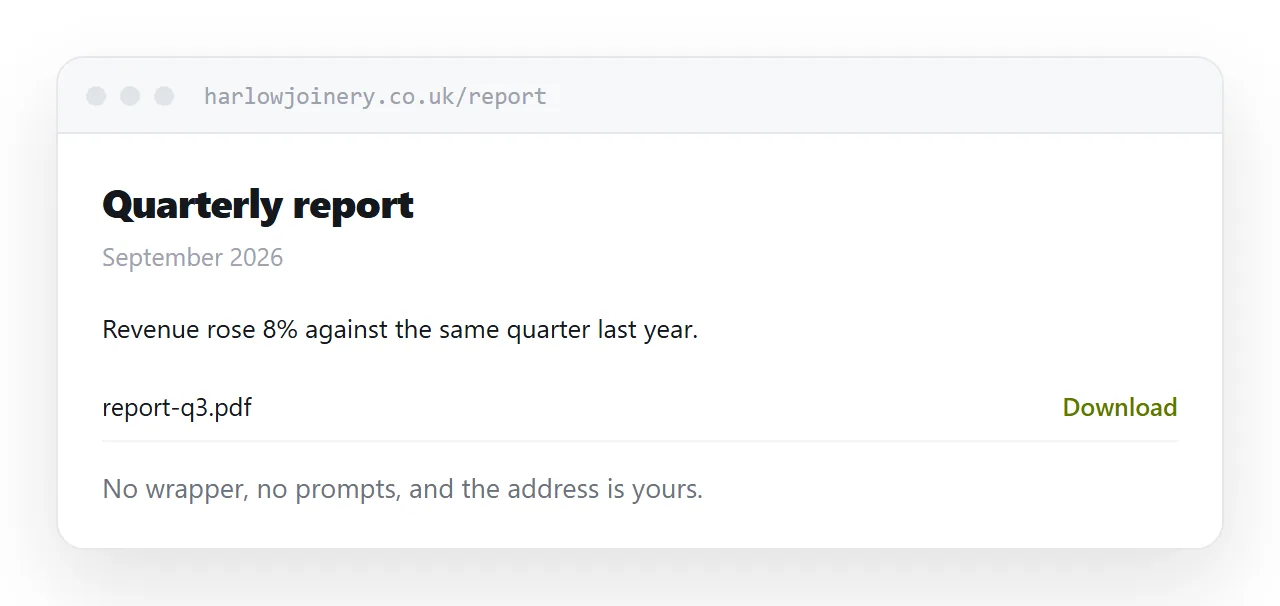
The strongest version of hosting it yourself is not uploading the file somewhere else. It is putting the content on a page, with the file available underneath.
Search engines read pages far more easily than documents. Readers get something that reflows to a phone. And you keep the document for anyone who wants to print or file it.
That combination usually outperforms a platform on discovery within a few months, because the content is at an address you own rather than inside somebody else's site.
Platforms change their minds
This is the part worth thinking about before publishing a hundred links.
A platform can add a paywall, restrict downloads, change its address scheme, or close. Every one of those has happened, and each time, every published link into it broke.
Documents at your own address survive all of it, because the only party involved is you.
Using both
If discovery genuinely matters, publish in both places.
Keep your address as the canonical version, put the content on a page there, and use the platform as a secondary distribution channel pointing back to it.
That way the platform works for you without owning the thing it is pointing at.
Closely related: PDF storage and hosting, and How to share a PDF as a link for the adjacent problem. Publishing from a terminal or from a browser is also close.
Put it at an address
Decide whether you actually need their audience, host client-facing work at your own address, put the content on a page rather than only the file, keep the address yours, and use a platform as a secondary channel if discovery matters.
Then the reader sees your document rather than somebody else's product.