Script formatting is one of the few places where a fixed page is unambiguously correct. What the address adds is everything around it.
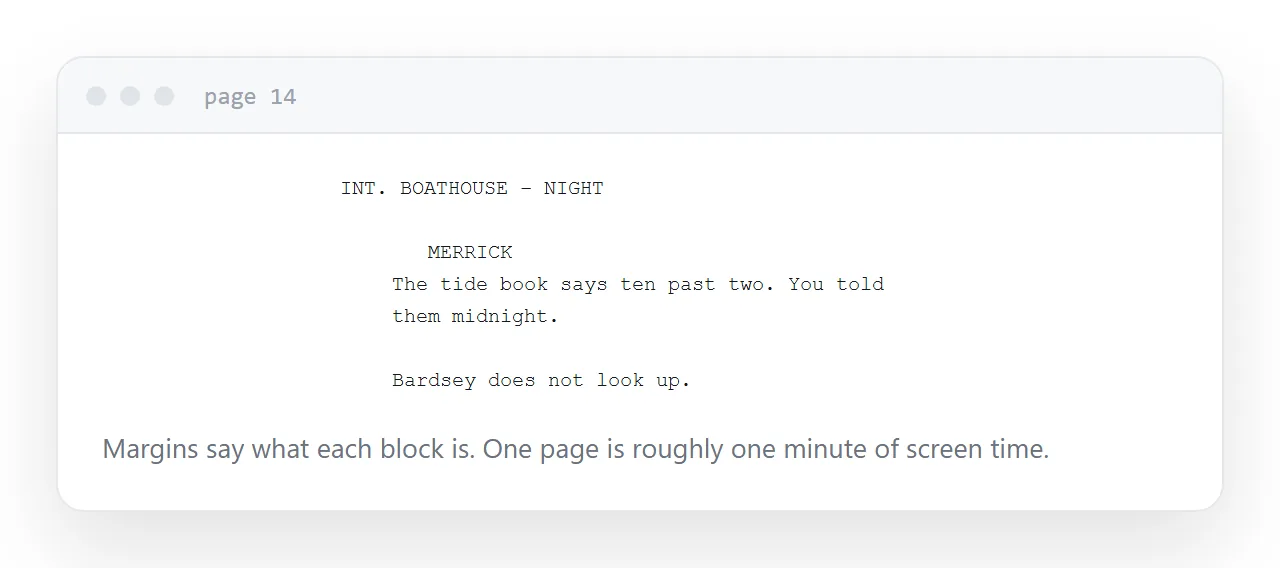
Why the format stays fixed
Screenplay formatting is a standard, and it carries information.
Margins indicate what each block is. Capitalisation marks characters and transitions. A page corresponds roughly to a minute of screen time, so length is a schedule and a budget rather than a word count.
Reflowing to a phone screen would destroy the page relationship and the visual grammar with it. This is genuinely a document rather than a page, and it should stay one.
| Attachment | At an address | |
|---|---|---|
| Formatting preserved | Yes | Yes |
| Opens on a phone | Downloads | Opens |
| You learn it was read | No | Yes |
| Can be withdrawn | No | Yes |
| Recipient named on it | Manually | Per address |
What the address gives you
It opens. No download, no application, no folder on a phone.
You learn it was opened, and when. For a writer waiting on a reader, that single fact changes the follow-up from a guess to a decision. Unopened after ten days is a different message from opened three times.
You can withdraw it. A competition closes, a version is superseded, a relationship ends. An attachment is gone forever; an address can be taken down.
Privacy setting
An unguessable address, not a public one.
Not findable in search, not reachable by anyone who was not given it, and no sign-in for the reader. That is the right level for a script going to an agent, a producer or a reader.
For a submission, or anything you are genuinely protective of, add a password and send it separately.
Watermarking
Standard practice and it works.
Each copy carries the recipient's name, usually lightly, on every page. It discourages forwarding, and if a copy appears somewhere it should not, you know which one it was.
A separate address per recipient does the same for opens: you can see who read it rather than that somebody did.
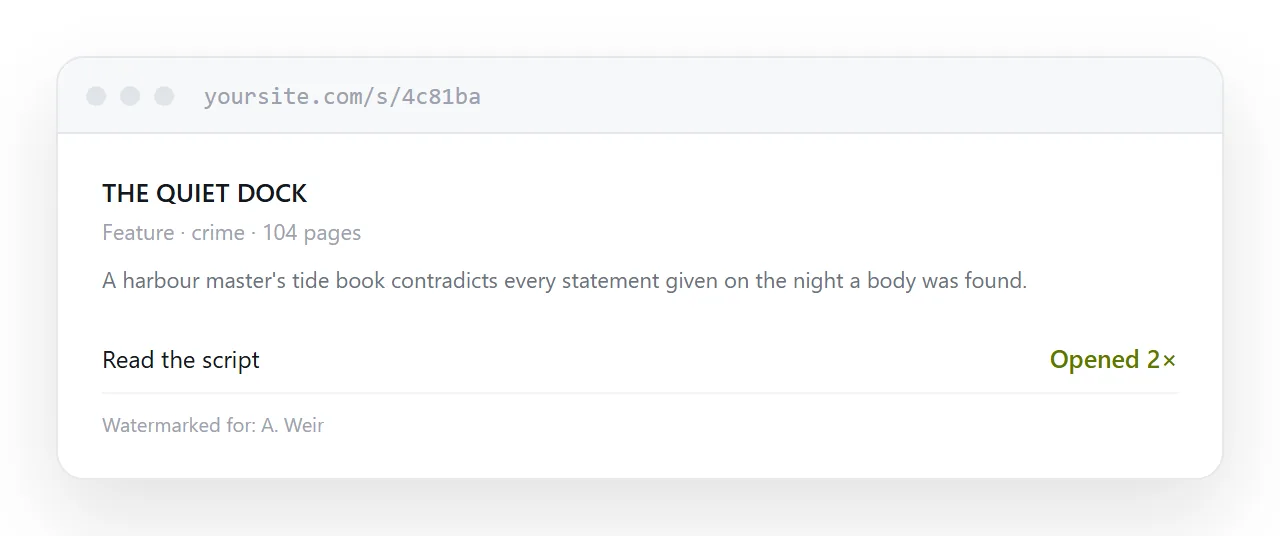
The four facts above it
A reader deciding whether to start wants: the title, the format and genre, the length in pages, and a one-line premise.
Put those on the page above the document. It takes ten seconds to read and it is what determines whether page one gets opened at all.
Add your name and one contact route. Nothing else.
Two neighbouring cases are worth a look: How to share film production files and How to publish a novel online.
Put it at an address
Keep the fixed formatting, publish at an unguessable address, watermark each copy with its recipient, put the four facts above the document, and use the open notification to decide when to follow up.