Video is the one file type where the size is not negotiable, and the first decision determines everything.
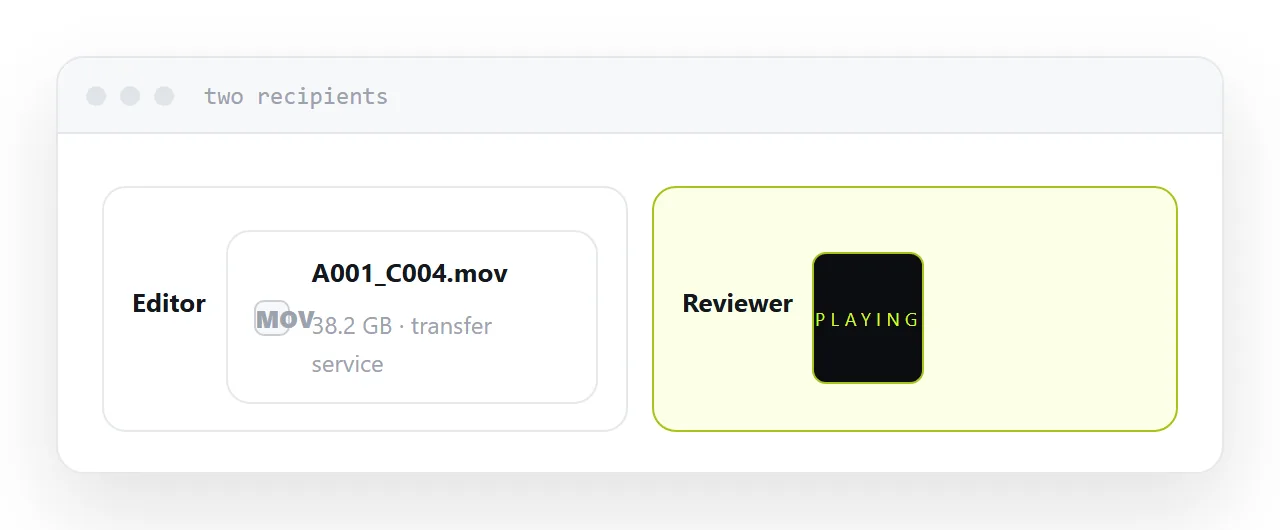
Who is receiving it
An editor, a colourist, a printer. They need the actual bytes at full quality. Compression is loss and loss is unacceptable.
A client, a producer, anyone approving. They need to watch it. The file is an obstacle.
Sending raw footage to the second group is the common mistake, and it costs them hours of connection time to see something they will watch once at a fraction of the quality.
| Editor | Reviewer | |
|---|---|---|
| Needs | The original bytes | To watch it |
| Route | Transfer service | A link that plays |
| Size | Full | Review quality |
| Download | The point | An obstacle |
| Checksum | Worth it | Irrelevant |
For the editor
A transfer service built for large uploads. Resumable, no size limit that matters, and designed for exactly this.
For footage where a corrupted frame is expensive, send a checksum alongside and ask them to verify. It takes a minute and it catches the transfer that completed and is wrong, which does happen.
Name files consistently and include a manifest. An editor receiving four hundred clips named by camera default spends the first hour renaming.
For the reviewer
Compress and put it at an address that plays.
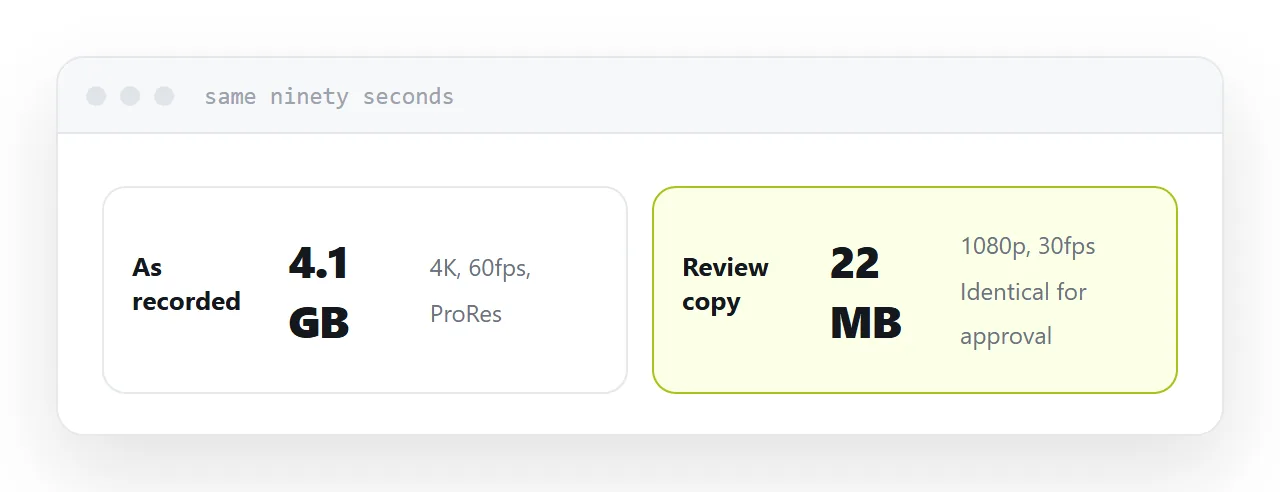
Resolution is where the saving lives. Footage recorded at maximum settings is far beyond what is needed for approval, and a review copy at a sensible resolution looks identical on the laptop or phone it will be watched on.
Frame rate halves it again for anything recorded at high speed, and is invisible for talking-head or screen footage.
The reviewer taps, it plays, they comment. No download, no application, no format problem.
Why a link beats a downloaded file for review
Video formats are a container plus a codec, and not every device supports every combination. A file that plays on your machine fails on theirs with an unhelpful error and neither of you can diagnose it.
A video that plays in a browser avoids this entirely, because the page serves a format the browser definitely supports.
It also means they can watch on a phone, which is where a surprising share of approvals happen.
Very large transfers
Past a few terabytes, uploading is measured in days and physical media is genuinely faster. Production has always known this and it is easy to forget.
Do the arithmetic before committing to a week of uploading: total size divided by actual upload speed, not advertised.
Privacy
Unreleased footage should be at an unguessable address with access withdrawn when the review round closes.
Assume anyone who can watch it can record it. Withdrawal ends ongoing access, which is worth doing and is not control.
If this is near what you are doing, How to send video files and How to send large files over email cover the cases on either side.
Put it at an address
Ask whether they need the file or the picture, send originals to editors through a transfer service, send reviewers a compressed link that plays, compress by resolution first, and price physical media for very large transfers.
Then nobody downloads forty gigabytes to watch ninety seconds.