These two kinds of service get compared constantly and they answer different questions.
What each one is
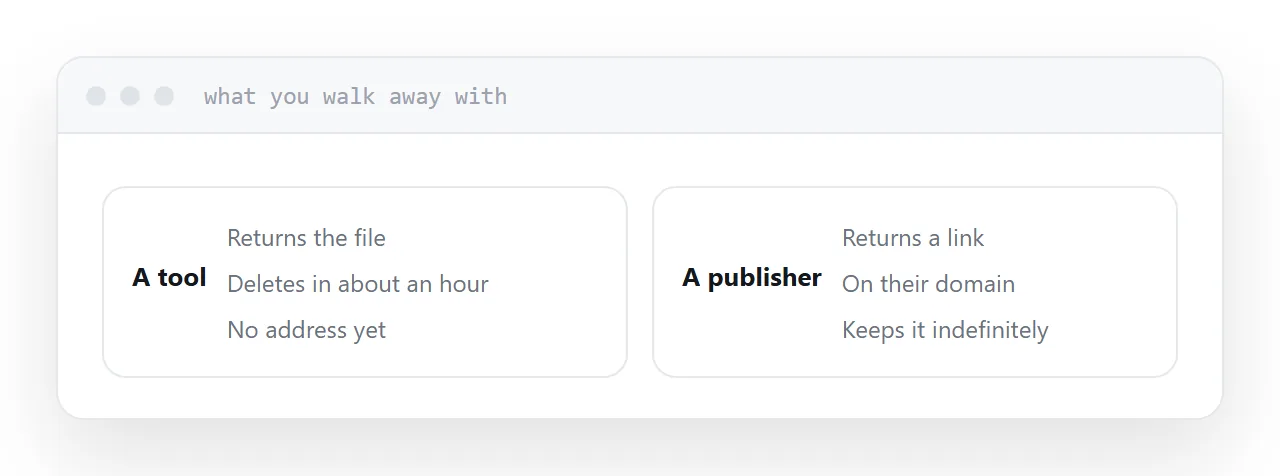
A tool performs one operation, compressing, merging, splitting, converting, and hands the file back. You take it away. The service typically deletes the upload within an hour, which it will usually tell you.
A publisher takes the document and hosts it. You get a link on their domain, and visitors see the document inside their reader, with their navigation, their branding and sometimes their advertising.
If you want a file, the first. If you want a link, the second, and then a further question.
| Tool | Publisher | |
|---|---|---|
| You end up with | A file | A link |
| The address is | Yours, nowhere yet | Theirs |
| The interface is | None | Theirs |
| Retention | Usually an hour | Indefinite |
| Cost of leaving | Nothing | Every link breaks |
The question about publishers
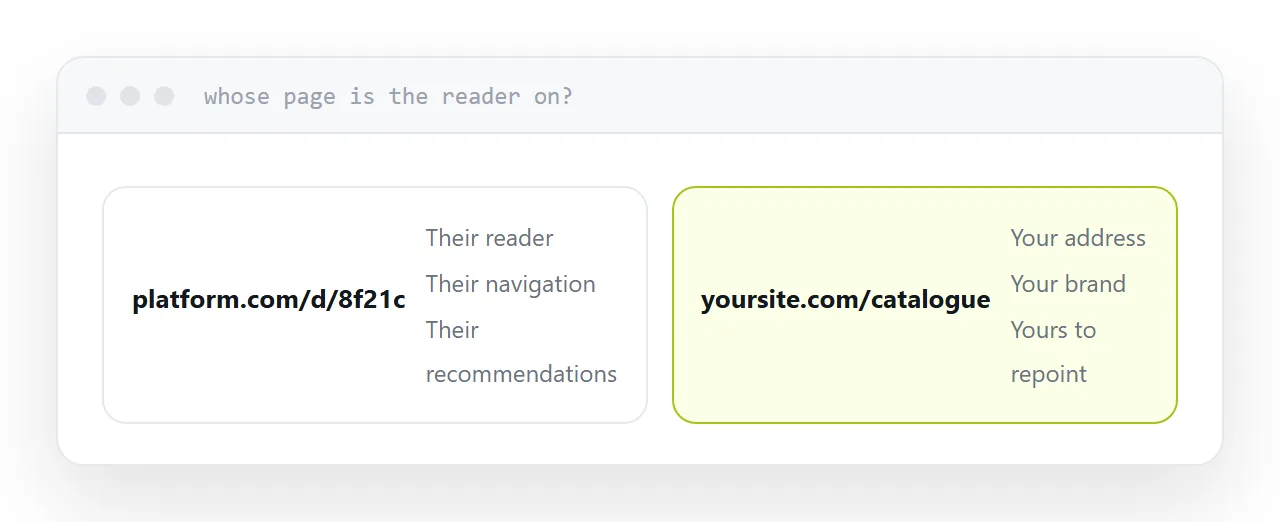
Whose page is a reader actually on?
The document is yours. The address, the reader interface, the branding around it and the recommendations underneath it are not. For a magazine or a catalogue, that means your customer is reading your material on somebody else's page, with somebody else's suggestions next to it.
Sometimes that is an acceptable trade for a viewer you did not have to build. It is worth deciding rather than discovering.
Free tiers and locked documents
Publishing platforms are hosting costs, and hosting costs grow.
The recurring pattern is a free tier that becomes limited: view counts capped, downloads restricted, documents placed behind a sign-up. Your document is still there and the people you sent it to now meet a wall.
If the link has been printed or widely circulated, you cannot fix that quietly.
The third option
Publish the document at your own address.
It displays in the browser, on any device, with no reader interface but yours. The link is on your domain, which means it keeps working regardless of what any platform decides, and it is yours to repoint if the document moves.
For a catalogue, a brochure, a price list or a report, this is usually what people wanted from a publishing platform in the first place. They went to the platform because the step of getting a document to display at an address was the part that looked difficult.
For the surrounding ground, see Comparing document publishing platforms and Choosing a document hosting alternative.
Put it at an address
Decide whether the outcome is a file or a link, check the retention period on tools, check whose brand surrounds a published document, watch what happens to free tiers, and publish at your own address when the document is yours.