Every generator takes content, applies templates and writes pages. The differences that matter are about maintenance rather than capability.
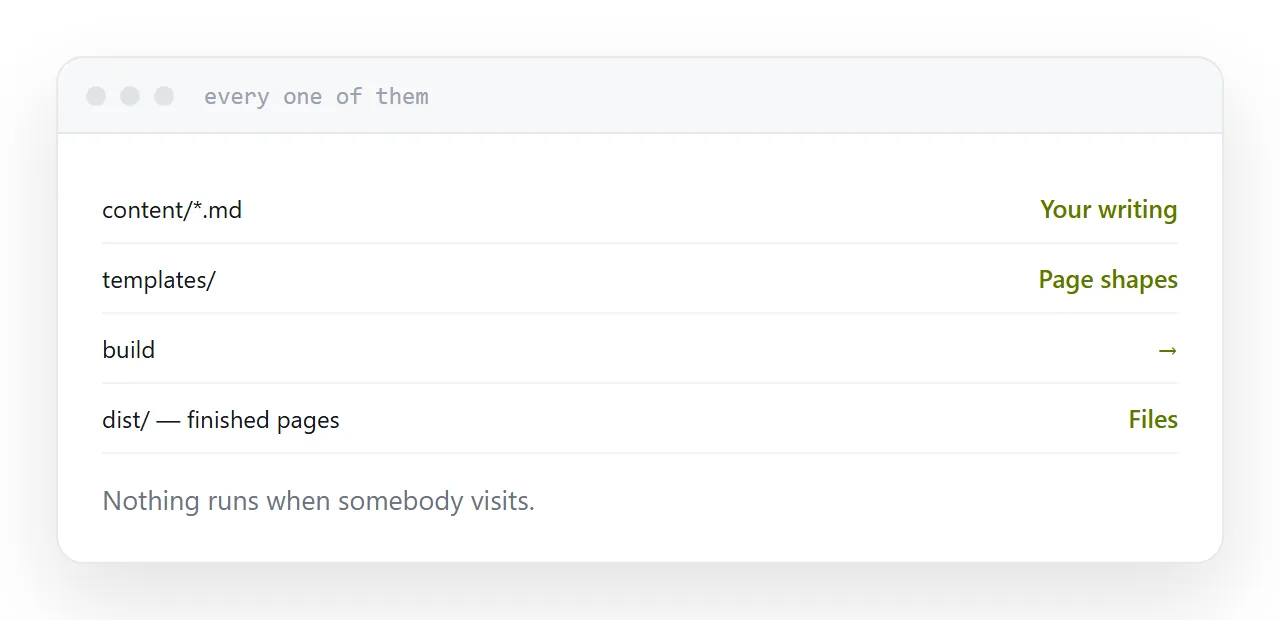
They all do the same thing
Content in a source format, templates describing the pages, configuration, and a build command that produces a folder of files.
Feature comparisons between them are mostly about which extras are built in, and those extras are rarely the deciding factor. The deciding factors are the language and the dependencies.
| Choose by | Not by |
|---|---|
| Language your team reads | Benchmark build times |
| Number of dependencies | Number of plugins |
| Whether it builds in three years | Popularity this year |
| Content in plain text | Theme gallery size |
The language matters more than the features
Something in the build will break, and somebody will have to read the error.
If that error is in a language nobody on the team uses, a small problem becomes an afternoon and eventually becomes a reason the site stops being updated.
Choose the ecosystem your team already reads. That single criterion outweighs most feature differences.
Dependencies decide whether it still builds
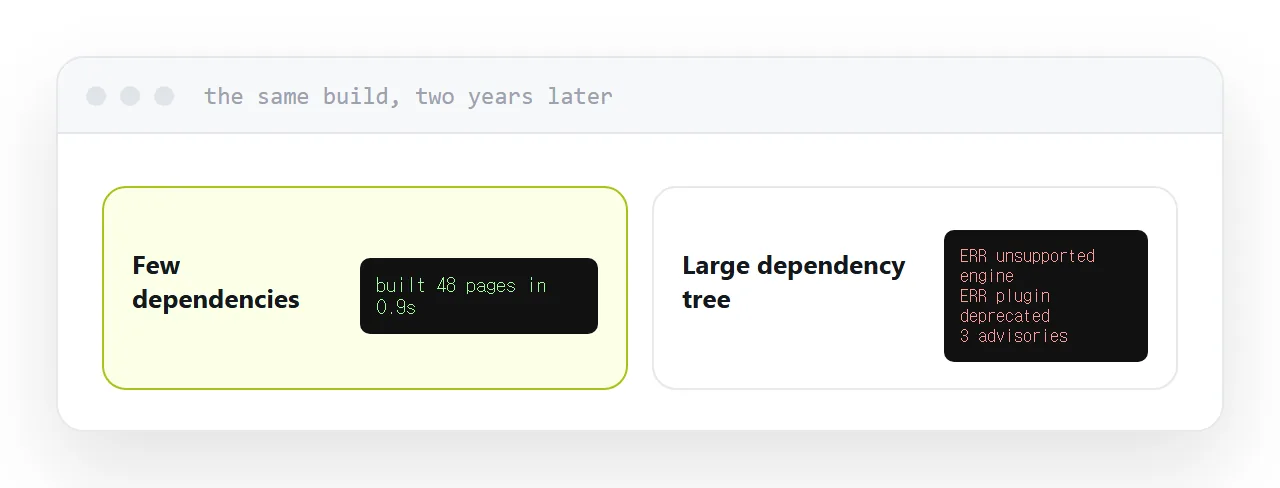
The practical failure with static sites is not the hosting. It is coming back after two years, running the build, and watching it fail.
Generators distributed as a single binary tend to keep working. Generators with a large dependency tree in a fast-moving ecosystem frequently do not: a dependency has a security advisory, the runtime has moved on, and a plugin was abandoned.
Neither is wrong, and the difference should be a known cost rather than a surprise.
Keep content in plain text
Whatever you choose, keep the content in plain text with light markup, separate from the templates.
Then the generator is replaceable. Changing it means rewriting templates, which is a week, rather than migrating content, which is a project.
Content outlives every tool that renders it, and treating it that way is the most useful structural decision available.
Build speed is mostly irrelevant
Below a few hundred pages, every generator builds in seconds.
The benchmarks comparing them run at tens of thousands of pages, which is not the situation almost anybody is in. Choosing on build speed for a fifty-page site is optimising something that was never a constraint.
When you do not need one
Under about ten pages, a generator is machinery around a small amount of markup.
Write the pages, share a stylesheet, and add a generator when repeating the header across eleven files starts to hurt. That moment is unmistakable when it arrives.
For the surrounding ground, see What people mean by a static site and What a static website is.
Put it at an address
Match the language to whoever maintains it, count the dependencies, keep content in plain text and separate, ignore build speed below a few hundred pages, and skip the whole category under ten pages.