The same five decisions apply whether the work is design, writing, code, teaching or photography. The medium changes and the decisions do not.
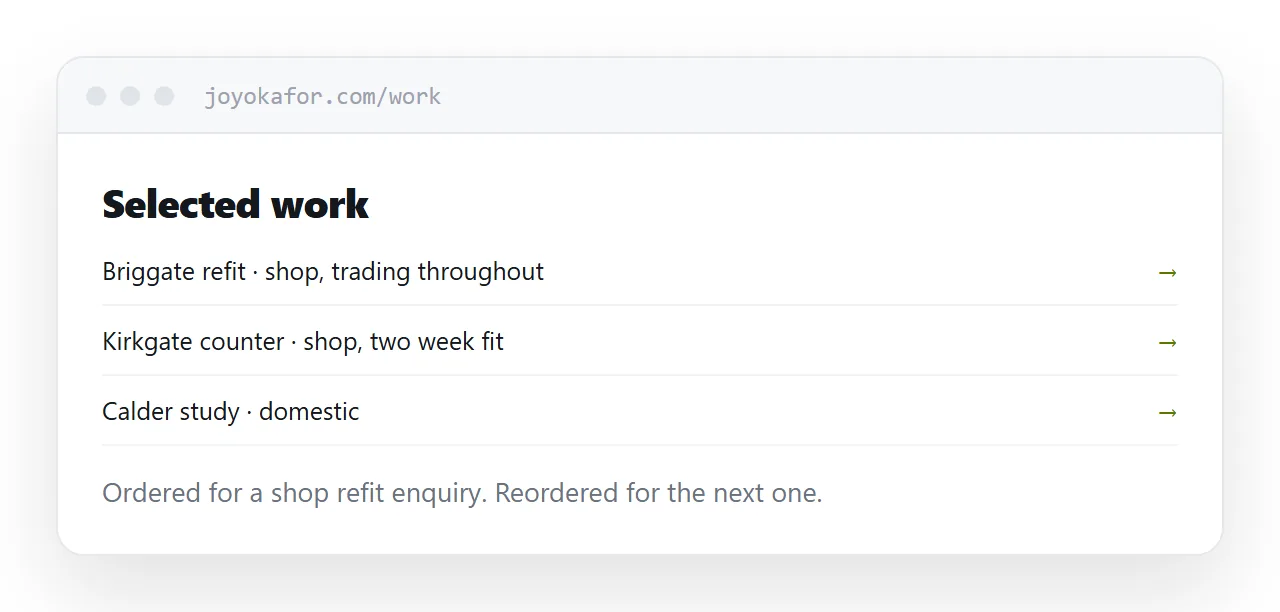
One: order for the work you want
Not chronologically, and not by which piece you are proudest of. Those are frequently different from the piece that gets you the next job.
A reviewer reads the first piece properly, skims the second, and scrolls the rest. Whatever is first defines what you are.
If you want environment work, lead with environments. If you want regulated writing, lead with the regulated piece. This means reordering per enquiry, which per-piece addresses make trivial.
Two: the floor is what gets judged
A portfolio of twelve pieces where four are excellent and five are ordinary is judged on the ordinary ones.
That is not unfair. The excellent piece might have taken a month with unusual support. The ordinary ones show what an ordinary week produces, and that is what somebody is buying.
Cut anything you would have to explain away. Four strong pieces beat twelve mixed ones, and the edit is itself being assessed.
| Twelve mixed | Five strong | |
|---|---|---|
| Judged on | The weakest | The work |
| Shows editorial judgement | No | Yes |
| Reviewer reaches the end | No | Sometimes |
| Loads quickly | No | Yes |
Three: the brief, not just the artefact
Work without context invites the reviewer to imagine a different solution. That is the natural reaction and it works against you.
Four short sections per piece.
The problem, stated as the client or the situation stated it.
The constraint. What made it hard. Budget, regulation, a deadline, a technology, an audience.
What you did.
What happened. Measured if you can, described honestly if you cannot.
The same piece with those four reads as a solution rather than as an opinion.
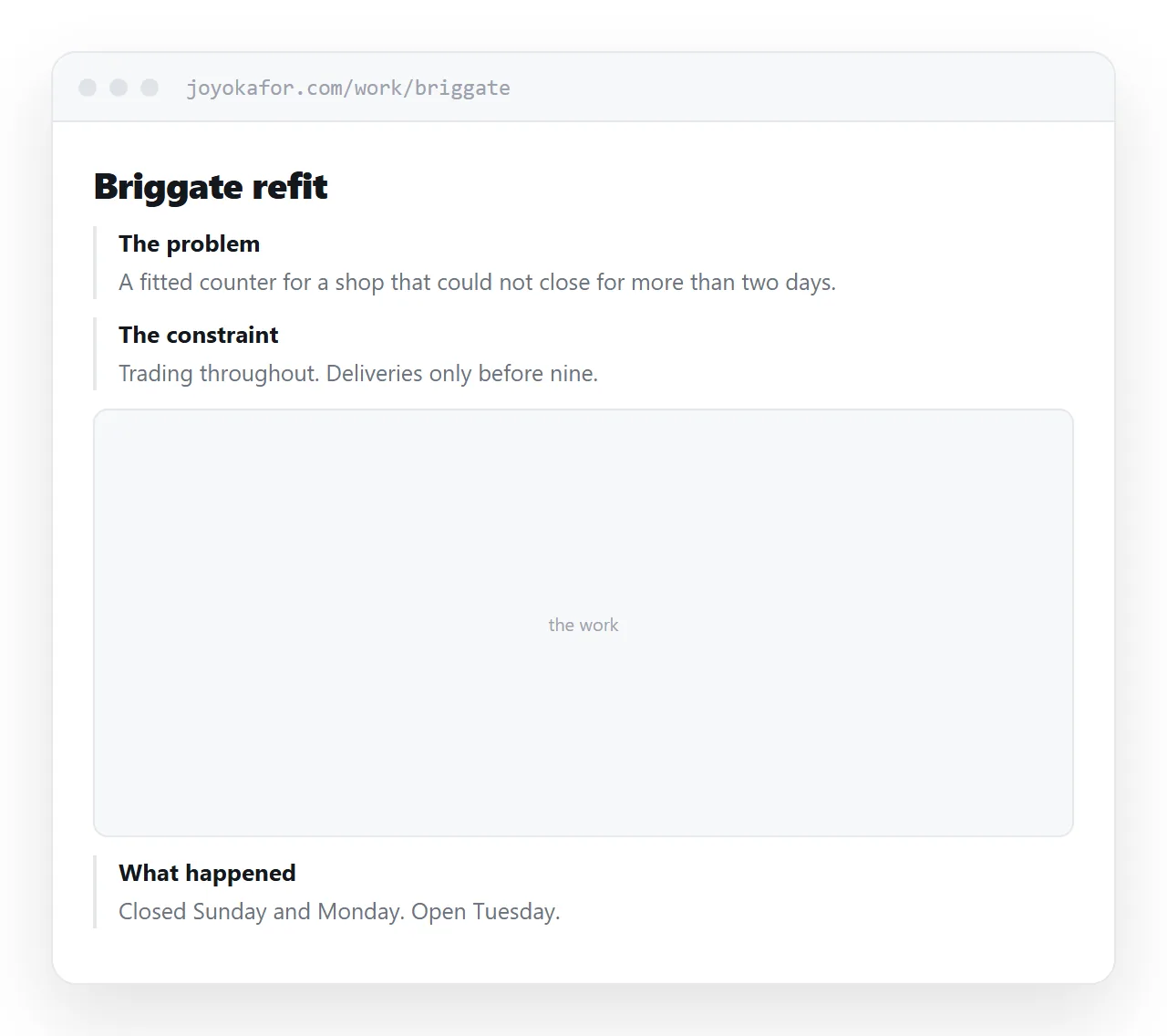
Four: one address per piece
This is what turns a portfolio from decorative into useful.
Somebody enquires about a specific kind of work. You send the two relevant pieces with a line each saying why. That is a strong reply.
Sending a link to everything asks them to do the matching, and most will not.
It also means individual pieces get found in search by people describing their problem, which brings enquiries from people who have never heard of you.
Five: restricted work
Most professional work is under an agreement.
Describe the problem, the constraint and the approach without naming the client or showing the material. That carries most of the persuasion and demonstrates something extra: that you do not show other people's work to strangers.
Ask the old client. Many say yes, particularly if the outcome was good.
For the surrounding ground, see An HTML portfolio template that opens in seconds and How to build a copywriter portfolio.
Put it at an address
Order for the work you want next, cut anything you would explain away, give every piece the brief and the outcome, publish each at its own address, and describe restricted work rather than showing it.
Then the portfolio answers the question somebody actually arrived with.