Operations, finance, analysis and project work produce no artefacts anyone can look at. That is the whole problem, and it is solved by writing rather than showing.
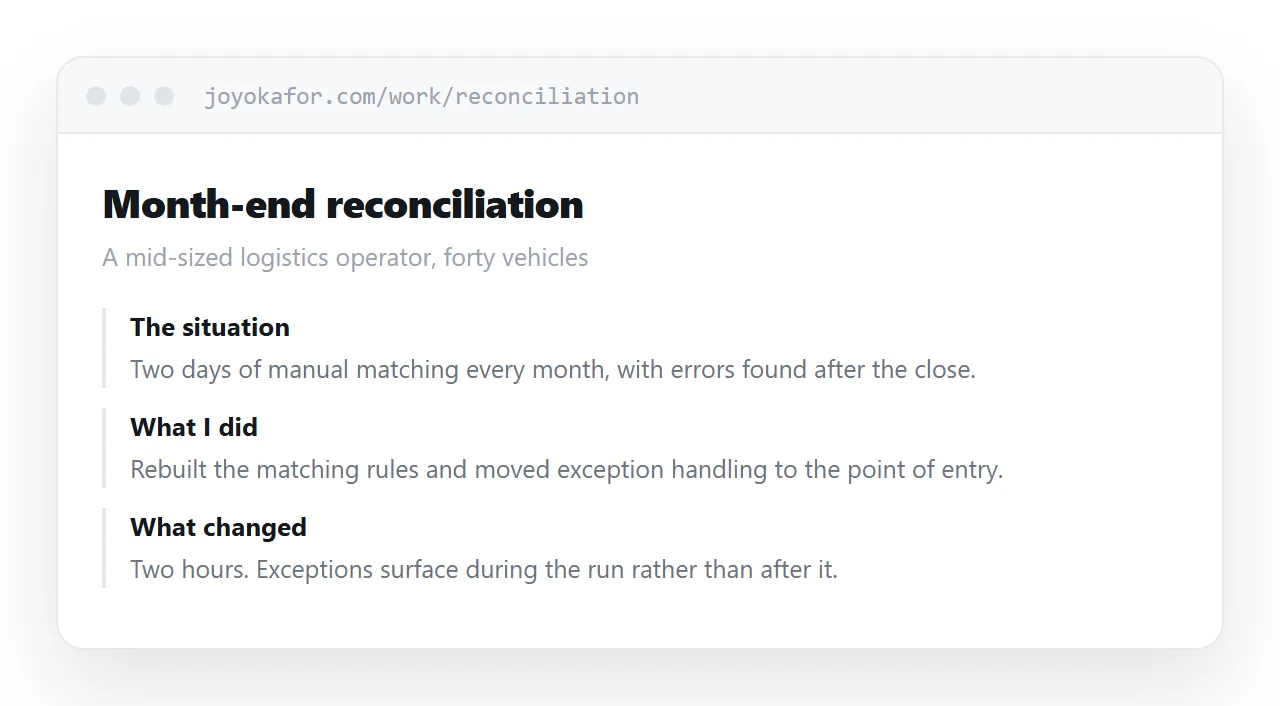
Three sections per case
The situation. What was happening and why it was a problem. Stated the way somebody in that industry would state it.
What you did. Specifically, and specifically what you did as opposed to what the team did. Reviewers discount vague collective claims because everybody makes them.
What changed. Measured where possible, described concretely where not.
Three short sections. Four cases. That is a complete portfolio for non-visual work and it takes an afternoon.
Figures without disclosure
Relative figures say what happened without disclosing anything commercial.
A reconciliation that took two days now takes two hours. A support queue that received eleven of the same question a week now receives none. A month-end close that ran to the fifth now finishes on the second.
All of those are concrete, verifiable in interview, and disclose nothing about revenue, customers or headcount.
| Discloses | Says as much | |
|---|---|---|
| Saved £240,000 | Yes | |
| Cut cost per order by 18% | No | Yes |
| Two days to two hours | No | Yes |
| Reduced a queue to nothing | No | Yes |
Describing the employer
Sector and size carries nearly all the relevance.
A mid-sized logistics operator with forty vehicles tells a reader whether your experience is relevant. The name adds credibility rather than fit, and frequently cannot be used anyway.
Saying plainly that the employer is not named at their request reads as discretion, which is itself reassuring.
Write it while it is fresh
This is the part that matters most and is skipped by almost everybody.
Six months after a project, the details are gone. Two years later you have a vague memory of an improvement and no figure. That is exactly when somebody needs a portfolio, and reconstruction produces the vague claims reviewers discount.
Write the case in the week the work finishes. Twenty minutes, while the numbers are still in front of you.
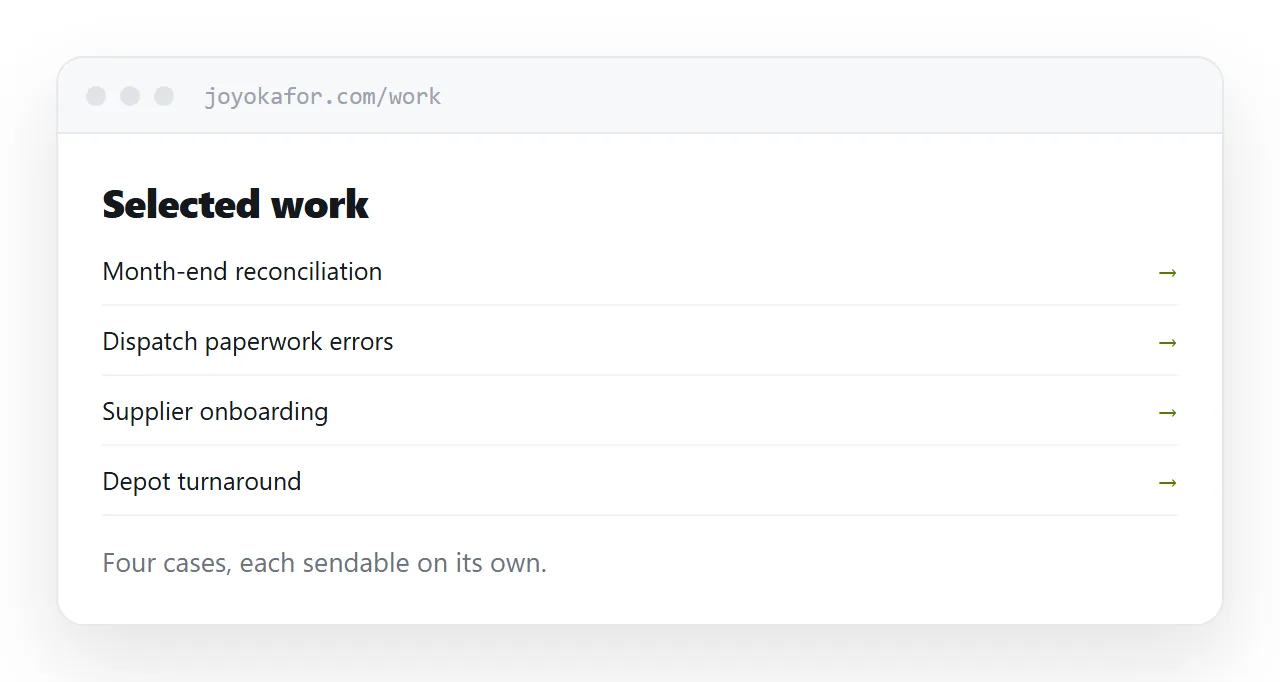
One address per case
It lets you reply to a specific opportunity with the specific relevant case and a line saying why.
That is a far stronger reply than a link to everything, and it is what turns a portfolio from a document into something that does work.
Two neighbouring cases are worth a look: How to make a portfolio and An HTML portfolio template that opens in seconds.
Put it at an address
Three sections per case, relative figures rather than absolute ones, the employer described by sector and size, written while the work is fresh, each case at its own address.
Then work nobody can see is still evidence.