University hosting is convenient and temporary, and the temporariness arrives at exactly the moment the work matters most.
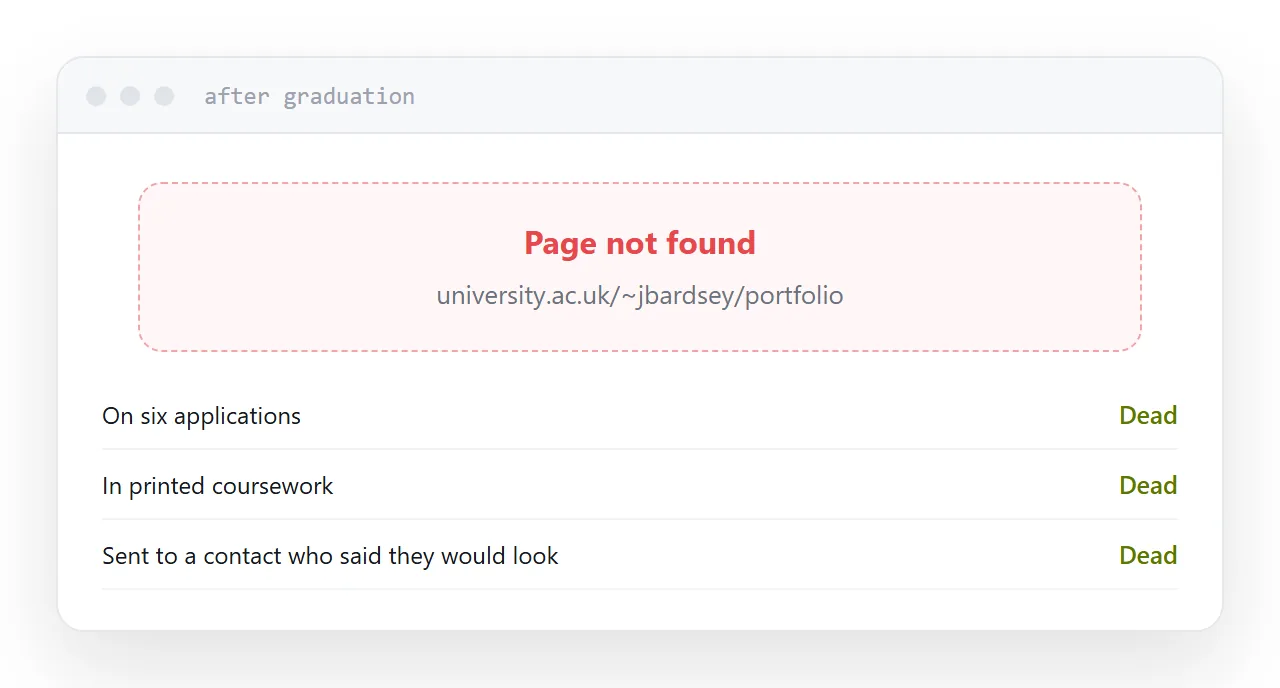
What happens at graduation
The account closes, usually within a few months and often without warning.
By then the address is on applications, in a portfolio submitted to six employers, in a message to somebody who said they would look at it later, and possibly in a printed piece of coursework.
Every one of those becomes a dead link, and there is no way to reach the people holding them. Nothing tells you it happened.
| Address | Lasts |
|---|---|
| University space | Until a few months after graduation |
| Free host subdomain | While that host exists |
| Your own domain | As long as you renew it |
What to do instead
Register your own name as a domain and host the work statically.
Static hosting for a portfolio is free at every provider that matters. The domain is a few pounds a year and it is the only recurring cost.
The address then works for the rest of your career: the applications made this year, the ones made in six years, and anybody who finds the work later.
Your own name
If your name is available, use it.
A project-specific name stops fitting when the project does. A name works for every job you apply for and every piece of work you do afterwards, and it is the address people will guess.
What to put on it
Not a list of module titles. Not a grid of screenshots.
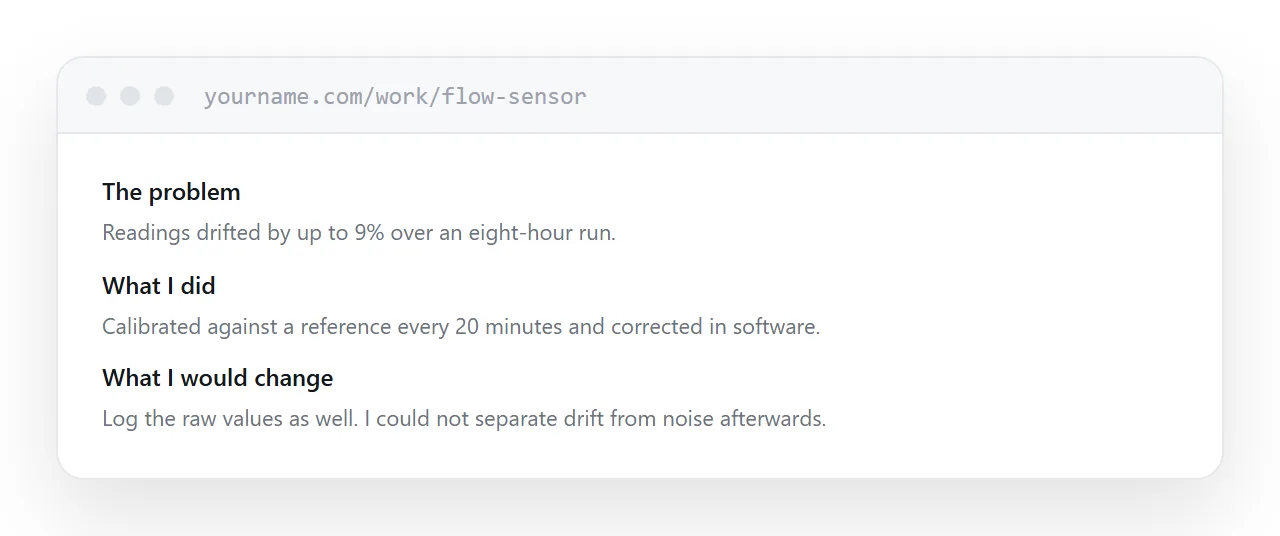
For each project: what the problem was, what you did, what the result was, and what you would do differently. That last part reads as competence rather than weakness, and it is what distinguishes a portfolio from a gallery.
Three projects written properly beat twelve thumbnails. Somebody assessing you reads the first one carefully and skims the rest, so put the strongest first.
Student credit
Free credit and discounted plans are genuinely useful for learning. Run a server, break it, rebuild it, understand how it works.
Keep that separate from anything you depend on. The discount ends at graduation, frequently at the same moment as everything else, and a portfolio running on expiring credit is the same problem in a different form.
Portfolio on static hosting with your own domain; experiments wherever the credit is.
Move before you graduate
While the university account still works, and while you can still check that everything transferred.
Afterwards, you are reconstructing from whatever local copies you happen to have.
For the surrounding ground, see How to build a student portfolio and How to share your resume as a link.
Put it at an address
Register your own name as a domain, host the work statically, write projects rather than module lists, keep free credit for experiments, and move everything before the account closes.