Meeting notes are written for a reader six months away who has one question: what did we decide, and who was doing what.
Almost nothing else in the notes will ever be read again.
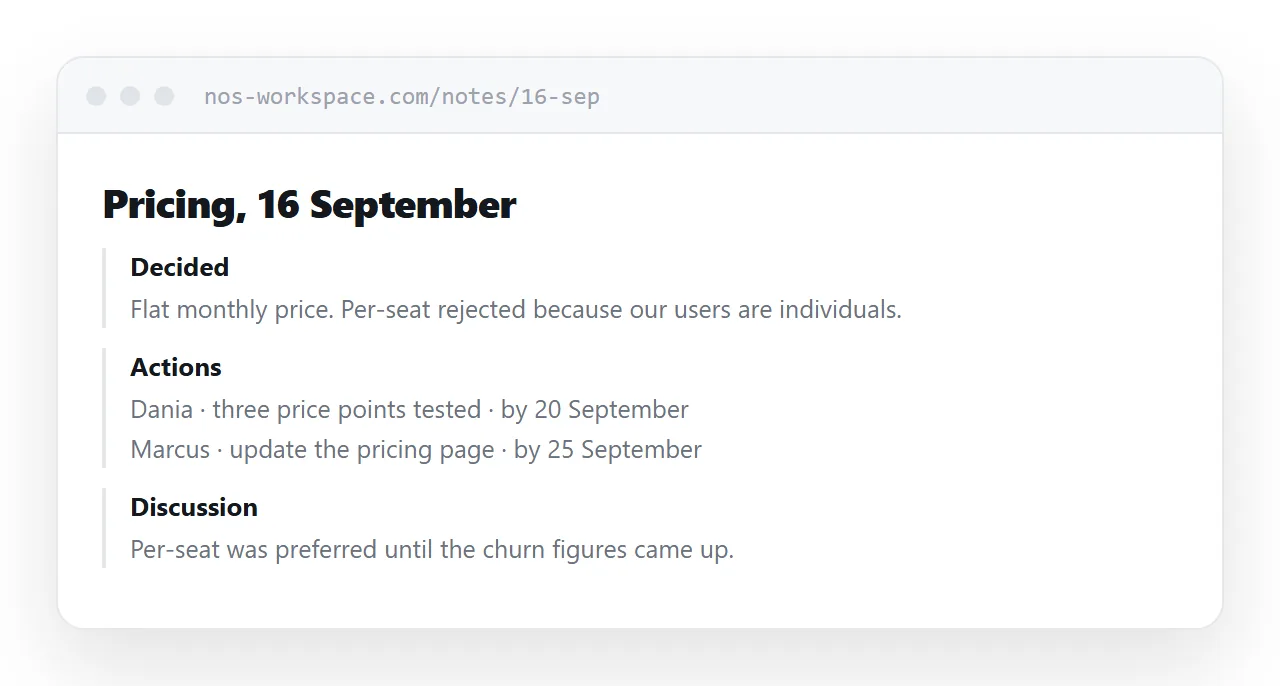
This guide covers the structure, actions, and where to put them.
Decisions and actions first
Three sections, in this order.
Decisions. What was decided, stated plainly, with enough context to be understood alone.
Actions. What will happen, who is doing it, by when.
Discussion. The reasoning, the options considered, anything unresolved.
Putting discussion first, which is how most notes are written, buries the two things anyone returns for.
Somebody opening the notes six months later should have their answer in the first screen.
Actions need a name and a date
An action with no owner does not happen. This is consistent enough to treat as a rule.
Every action line carries a person and a date. Not the team, not everyone, a person. If nobody will own it, it was not an action and writing it down is pretending.
The date does not have to be precise. Next Friday is a date; soon is not.
| Without owners | With owners and dates | |
|---|---|---|
| Gets done | Sometimes | Usually |
| Clear who to ask | No | Yes |
| Reviewable next meeting | No | Yes |
| Takes longer to write | Slightly |
One address per meeting
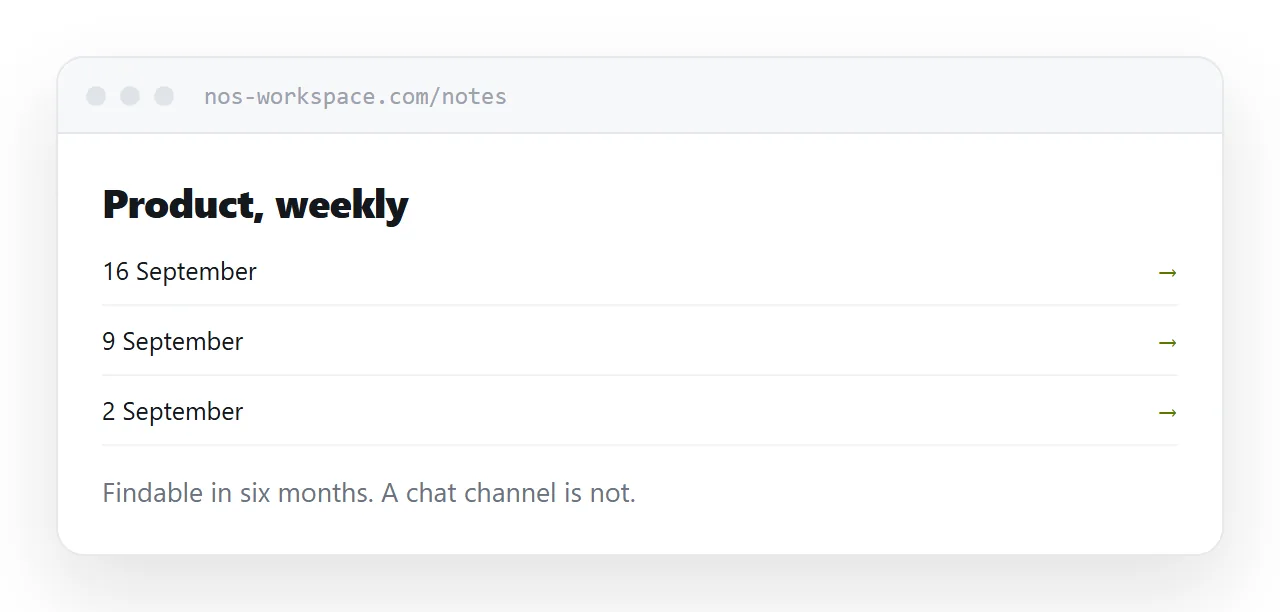
Chat channels scroll. Notes posted in one are unfindable within a fortnight, and searching chat for a decision made in March is unreliable at best.
Give each meeting its own address, listed under a page for the series. Permanently.
Then a decision from March has a link, the link can be sent in a later argument about what was agreed, and nobody is scrolling through a channel.
Do not transcribe
A near-verbatim record is unreadable and nobody returns to one.
The value is in the compression. Somebody reading it should understand what happened in two minutes, not relive the hour.
Capture the reasoning for decisions that were contested, because that is what saves reopening them. Skip the rest.
Publish within a day
Accuracy falls fast. Details blur, and the version that gets written a week later is a reconstruction.
Publish the same day if possible, and say plainly if something is unclear rather than smoothing it over. A note saying it was unclear whether the deadline covered testing is more useful than a confident sentence that turns out to be wrong.
Send it to everyone affected
Attendees already know what happened. The people who need the notes are frequently the ones who were not there: the team implementing the decision, the manager who needs to know, the person whose work changes.
Send the link to them explicitly rather than assuming it will reach them.
Closely related: How to put meeting notes online, and How to share a transcript as a link for the adjacent problem.
Put it at an address
Decisions and actions first with discussion below, every action owned and dated, one permanent address per meeting, published within a day, and sent to everyone affected.
Then the argument in six months has a link rather than two conflicting memories.