Meeting notes online are notes published at an address instead of attached to an email, so anyone who missed the meeting reads the same current version. The notes worth writing have three sections, take five minutes, and go up as the meeting ends.
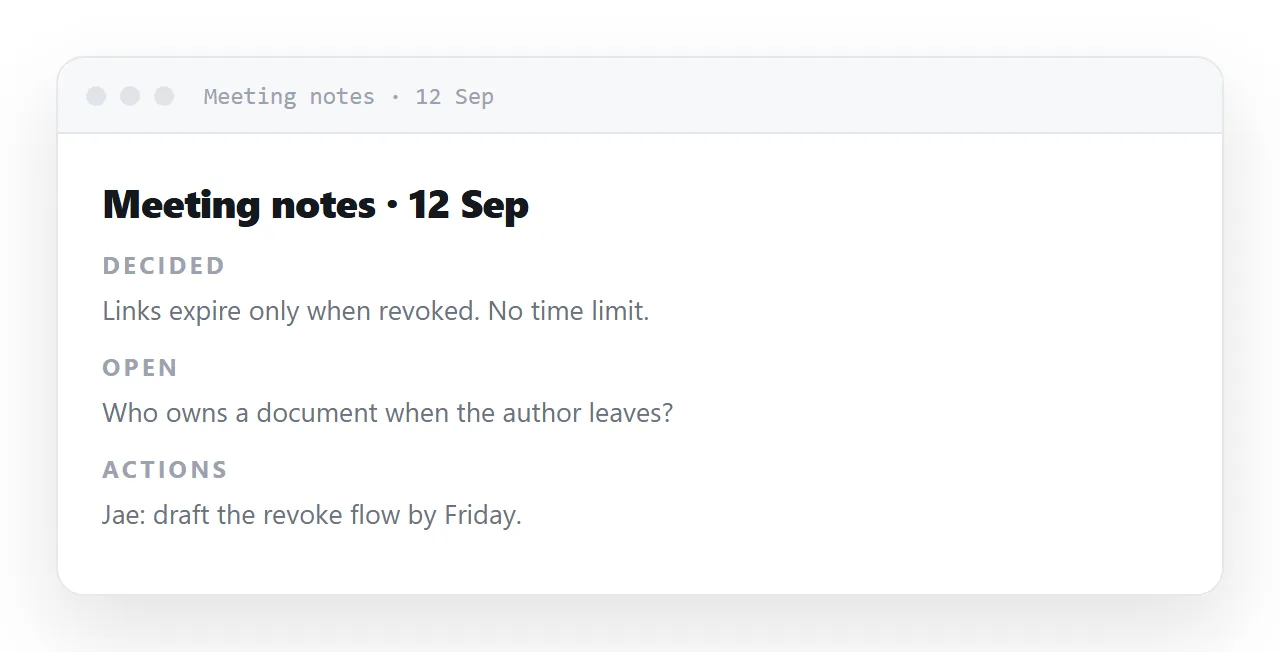
Most meeting notes are a chronological account of the conversation; nobody reads them, including the person who wrote them, and the decisions they contain are relitigated a month later because nobody can find them.
This guide covers the format, why the reason goes next to the decision, writing during the meeting, where the notes live, the follow-up message, and the four steps.
Most meeting notes are a chronological account of the conversation. Nobody reads them, including the person who wrote them, and the decisions they contain are relitigated a month later anyway.
Three sections fix it, and they take five minutes.
The HTML meeting notes format: three sections
<h1>Pricing review — 12 Sep 2026</h1>
<p class="meta">Mina, Jae, Sam · 40 minutes</p>

<h2 id="decided">Decided</h2>
<h2 id="open">Still open</h2>
<h2 id="next">Next</h2>
Nothing else. No attendee list beyond names, no agenda, no narrative.
Decided — with the reason
<li>
  <strong>Annual billing launches with a 20% discount.</strong>
  <br><span class="why">Because the monthly churn is concentrated in the first
  two months, and annual removes that window. Cost: we lose flexibility to raise
  prices for a year.</span>
</li>
The reason is what makes this section worth writing. In six weeks somebody who was not in the room will propose 15%, and a recorded reason ends that in thirty seconds instead of another forty-minute meeting.
Recording the cost of the decision matters too. A decision written down as having no downside will be reopened by the first person who notices the downside.
Still open — with an owner and a date
<li>
  <strong>Whether the annual tier includes the seat limit.</strong>
  Blocking the pricing page copy.
  <strong>Jae</strong> to decide by 18 Sep.
</li>
An open question with no name attached is not open, it is abandoned. Name and date, always.
Next — actions, not intentions
<li><strong>Mina</strong> — pricing page copy with the annual tier, 20 Sep</li>
<li><strong>Sam</strong> — check whether billing supports proration, 16 Sep</li>
"Team to look into proration" is how an action item dies. One name per item; a shared action has no owner.
Write them during the meeting
On the shared screen, as you go. Two things happen:
Disagreements surface immediately. Someone reads "decided: 20%" and says "I thought we were still discussing that". That correction costs ten seconds in the room and a week of confusion if it happens by email afterwards.
They get written at all. Notes deferred to afterwards are written by nobody, or written from memory — and memory reconstructs a cleaner meeting than the one that happened.
Where they live
/notes/2026-09-12-pricing-review
/notes/2026-09-19-pricing-review
One page per meeting, its own address. That address can be pasted into a ticket, a spec, or next month's agenda, and it still resolves a year later.
Not a channel post — channel messages are unfindable after a fortnight, cannot be linked from a document, and cannot be corrected.
What to leave out
Who said what. Unless it is a decision or a commitment, attribution invites defensiveness and adds nothing.
The discussion. The point of recording the decision and its reason is that the discussion does not have to be preserved.
Anything said in confidence. Notes get forwarded. An unlisted link is not a private document.
The link in the follow-up
Send the link, with the decisions as three lines in the message body. Not "notes attached" — the decisions, in the message, then the link for the detail.
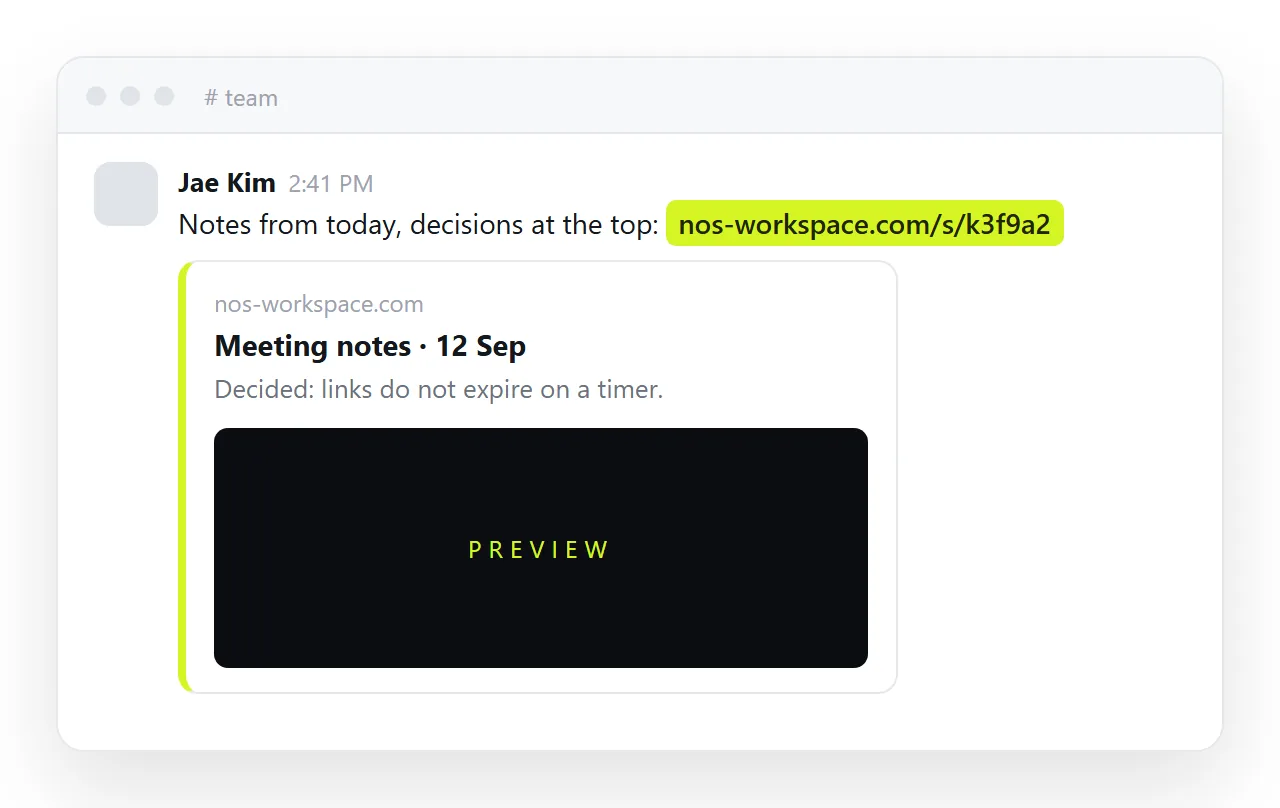
In NOS each meeting's page is a document searchable by its contents and editable by the people who were there. So the participant who notices a decision was recorded wrongly corrects it, at the same address, and everyone reading the link sees the correction.
What belongs where
| Content | In the notes | Elsewhere |
|---|---|---|
| A decision and its reason | Yes | |
| An open question with an owner and date | Yes | |
| An action with one name | Yes | |
| Who said what | Nowhere | |
| The discussion itself | Nowhere | |
| A figure that needs checking | The report it came from | |
| A design decision with lasting effect | Yes, and also | The spec |
The two "nowhere" rows are what makes the format fast enough to survive. Notes that attempt a record of the conversation take thirty minutes and get written once.
Finding a decision a month later
Notes at one address per meeting, in a series, are searchable by the decision's own words. "Why did we exclude trial accounts" finds the September sync, with the reason beside the decision. That is the whole return on the five minutes: the argument is not re-had, because the record is findable and it says why.
The follow-up message
Three lines in the channel or email — the decisions — then the link. Not "notes attached", which asks the reader to do work before learning anything.
One page per meeting, each with its own address, so it can be linked from a ticket or next month's agenda and still resolve a year later.
The recurring meeting
A weekly sync produces a series of notes, and the series is more useful than any one page.
Keep an index at one address with a line per meeting, so an open item from three weeks ago can be found and closed, and so a new team member can read a month of decisions in ten minutes.
The index is also where a decision gets linked from the spec that depends on it.
Notes nobody reads, and why these get read
Transcripts fail because they ask the reader to find the decision. These notes are read because they are short and because every line is either a decision, a person with a date, or an action. If a section grows past five lines, the meeting had too much in it, and the notes should say so rather than absorb it.
Writing the notes: 4 steps
- Open the page before the meeting starts. Title, date, who is there, and the three headings: decided, still open, next.
- Write decisions with the reason as they happen. One line each. The reason is what stops the decision being re-argued next month.
- Give every open item an owner and a date, every next item a name. No item without a person; no intention without an action.
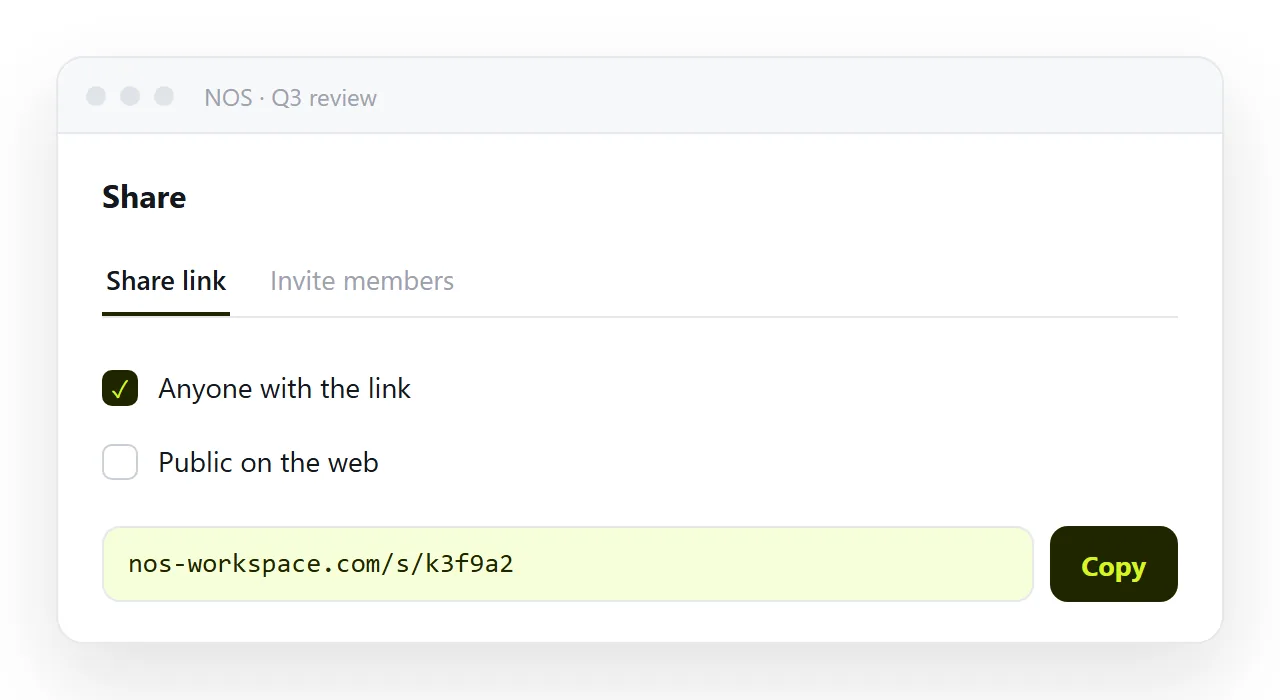
- Post the link as the meeting ends. Share, then Share link, then Create link. One line of follow-up and the address, nothing else. Turning HTML into a link is this step.