An FAQ page is worth having when you can send someone a link to one answer. Without that, it is a page customers are told to read and do not.
This guide covers where the questions come from, linking to a single answer, and the accordion question.
The questions come from your inbox
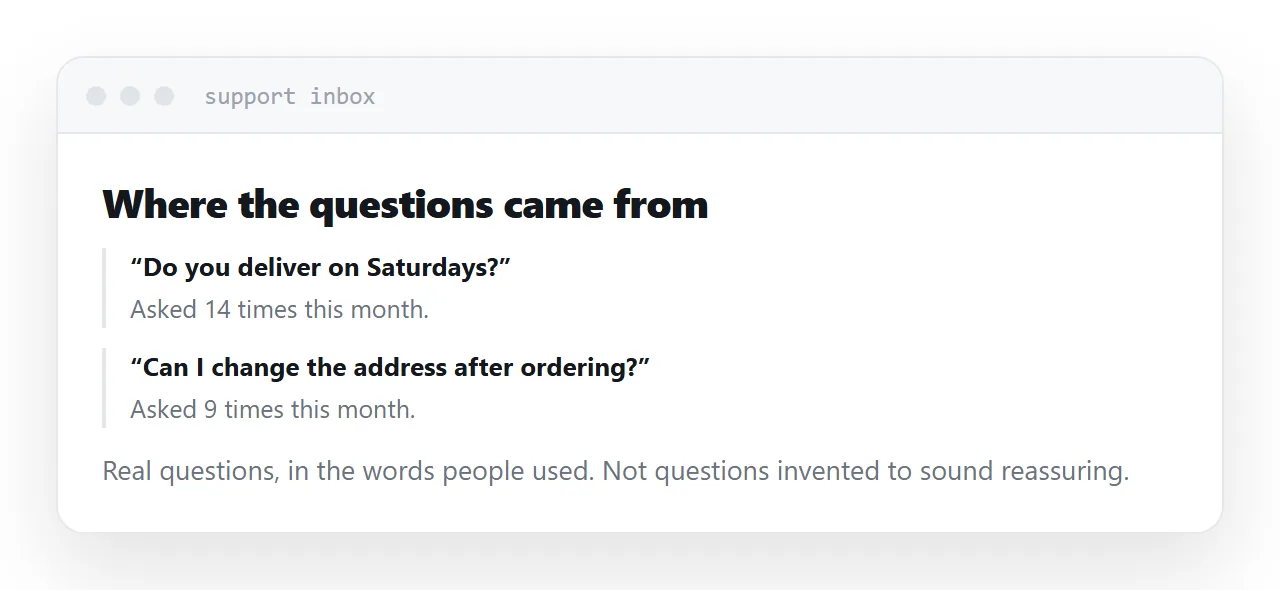
Almost every bad FAQ has the same cause: the questions were invented.
Invented questions sound like "Why should I choose you?" and "What makes your service different?" Nobody has ever typed those. They are marketing copy wearing a question mark, and readers recognise it instantly and stop trusting the page.
Real questions come from your inbox, your messages and your phone calls. They are specific, sometimes awkward, and phrased in the customer's words rather than yours.
"Do you deliver on Saturdays" is a real question. Keep the phrasing, because that phrasing is what someone types into a search box.
Linking to one answer is the point
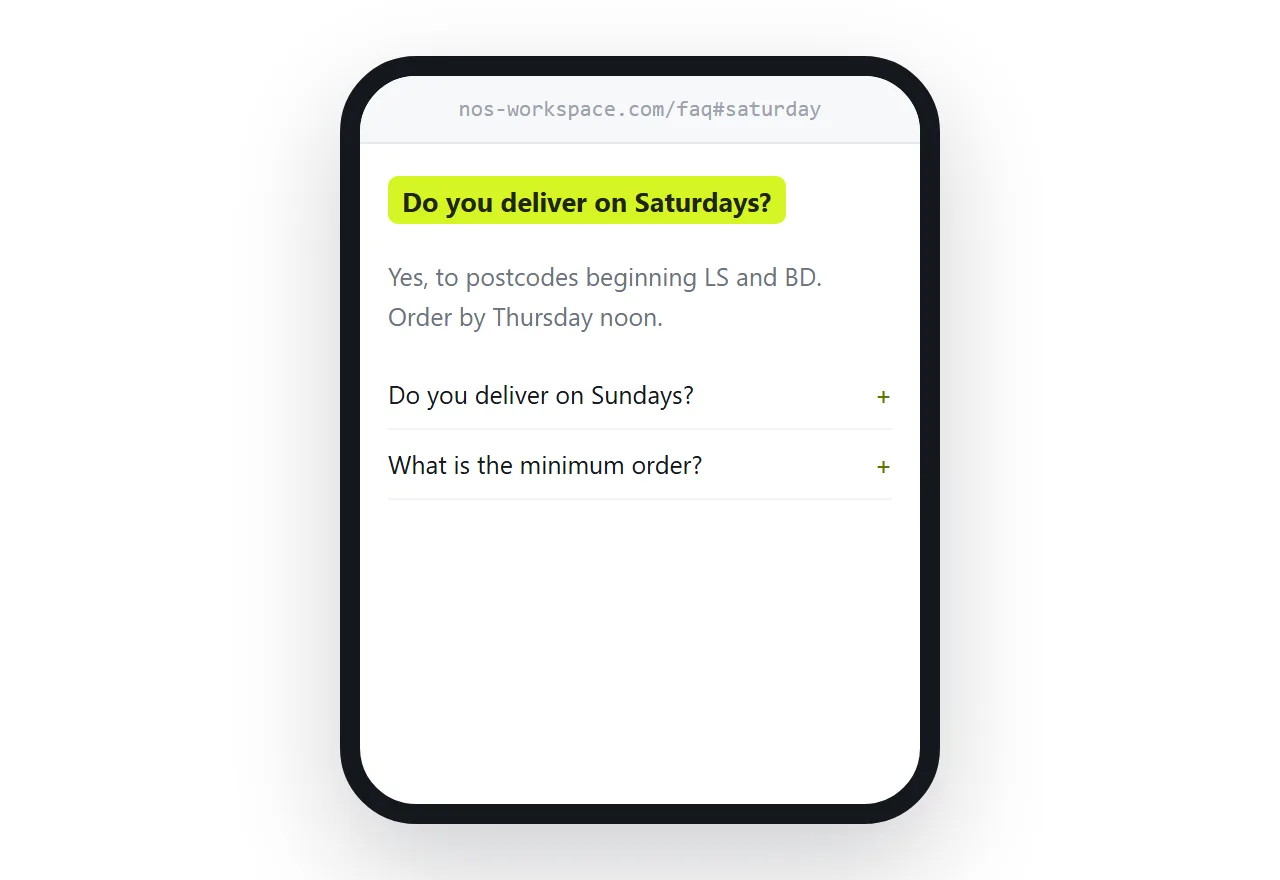
Give each question its own anchor so it can be linked to directly.
<h3 id="saturday-delivery">Do you deliver on Saturdays?</h3>
Then support sends one address that opens the page at that answer. Not "see our FAQ", not "it's about halfway down". One link, one answer, question closed.
That single feature is what turns an FAQ from a page nobody visits into the most-used document in the business.
| FAQ with no anchors | FAQ with anchors | |
|---|---|---|
| Support reply | "See our FAQ" | One link |
| Customer finds the answer | Scrolls and scans | Lands on it |
| Shareable | The whole page | One answer |
| Found in search | The page | The specific answer |
The accordion question
Collapsing answers so the reader sees only the questions is useful when the list is long. It lets them scan twenty questions in a few seconds.
It has two costs. The browser's find-on-page does not reach collapsed text in some implementations, so a reader searching for a word finds nothing. And a proportion of readers do not realise the questions open at all.
So: collapse a long list, leave a short one open, and make sure the questions clearly look tappable. If you collapse, make the linked answer open automatically when someone arrives from a direct link.
Two or three sentences
An FAQ answer that runs to four paragraphs is a page in the wrong place.
Answer in two or three sentences. If the full answer genuinely needs more, summarise it in the entry and link to the page that covers it. The reader who needed the short version is done; the reader who needed detail knows where to go.
Prune it
FAQ pages grow and never shrink, which is how they become walls.
Look at which entries are opened. If nobody has opened one in six months, the question is not frequently asked and it is making the frequent ones harder to find. Remove it.
Add an entry when the same question arrives twice. That is a good enough rule to keep the page matched to reality.
If this is near what you are doing, How to write a user manual and How to make a house manual for guests cover the cases on either side. How to make a QR code for a document is also close.
Put it at an address
Take the questions from your inbox in the customer's words, give each one an anchor, keep answers short, collapse only long lists, and prune what nobody opens.
Then answering a customer is a link rather than a paragraph you have written before.