HTML vs markdown for LLM input comes down to length against structure. Markdown is shorter for the same content, so it is the default, and HTML earns its extra length when the tags carry meaning markdown cannot express.
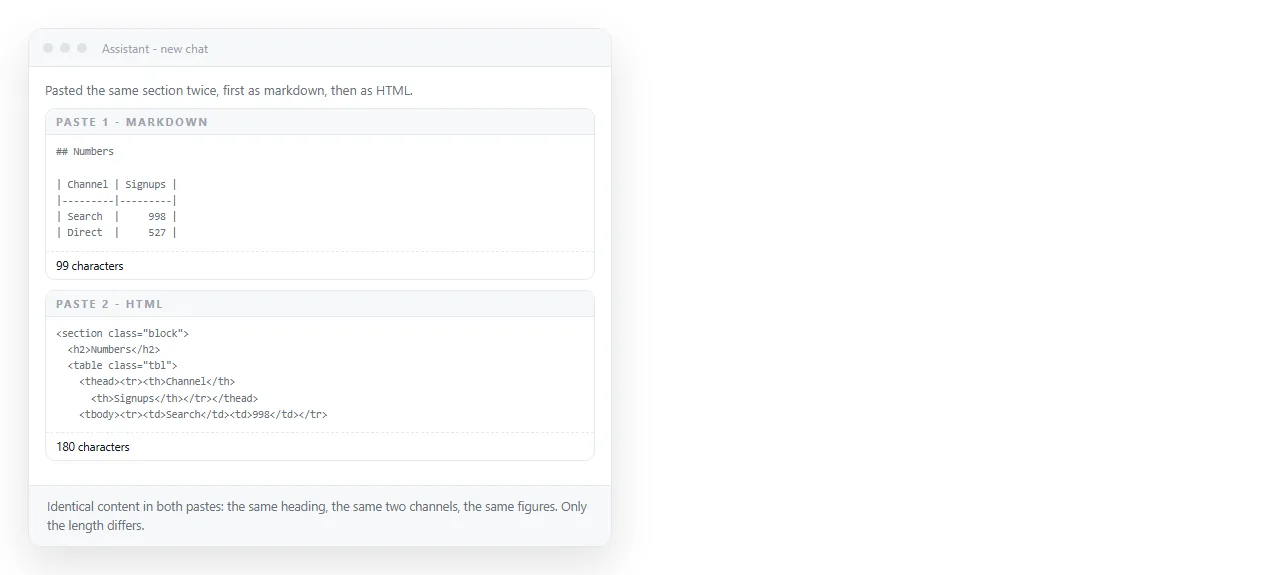
Comprehension is not the question. Models read HTML, including attributes and inline styles, without stumbling. The question is what you pay and what you keep.
HTML vs markdown for LLM input: what you pay
Markup is characters. Every opening tag, closing tag, class name and style attribute is part of the input.
The growth is uneven across document types, which is why a single rule for everything is wrong.
| Content | Markdown to HTML growth | Worth paying |
|---|---|---|
| Prose with headings | Small | Rarely |
| Bullet lists | Small | Rarely |
| Rectangular table | Large | No |
| Table with merged cells | Large | Yes, markdown cannot express it |
| Form or interactive page | Large | Yes, identity is the point |
| Page of layout containers | Very large | No, the growth is all wrapper |
The last row is the common case for anything copied from a live website, and it is the case where cleaning up first pays most.
What you keep
Markdown carries headings, lists, links, emphasis, code and rectangular tables. That covers most documents.
It cannot carry four things:
- Element identity. There is no equivalent of an id or a class, so nothing in the document can be referred to precisely.
- Attributes. Data values, timestamps and codes attached to elements have nowhere to go.
- Irregular tables. Row spans, column spans and nested tables flatten, and a flattened version of a merged cell table often reads as wrong rather than as simplified.
- Layout meaning. A side by side comparison becomes two stacked lists, and the pairing between them is gone.
If none of those appear in your document, converting to markdown loses nothing at all.
Cleaning HTML before pasting
Most of the length in a real page is not content. Removing it is more effective than switching formats.
- Drop script and style blocks. On many pages this alone removes over half the file.
- Drop navigation, footer and cookie banners. They repeat on every page and answer nothing.
- Drop class and style attributes unless you are asking about appearance.
- Keep headings, tables, lists, links and image alt text.
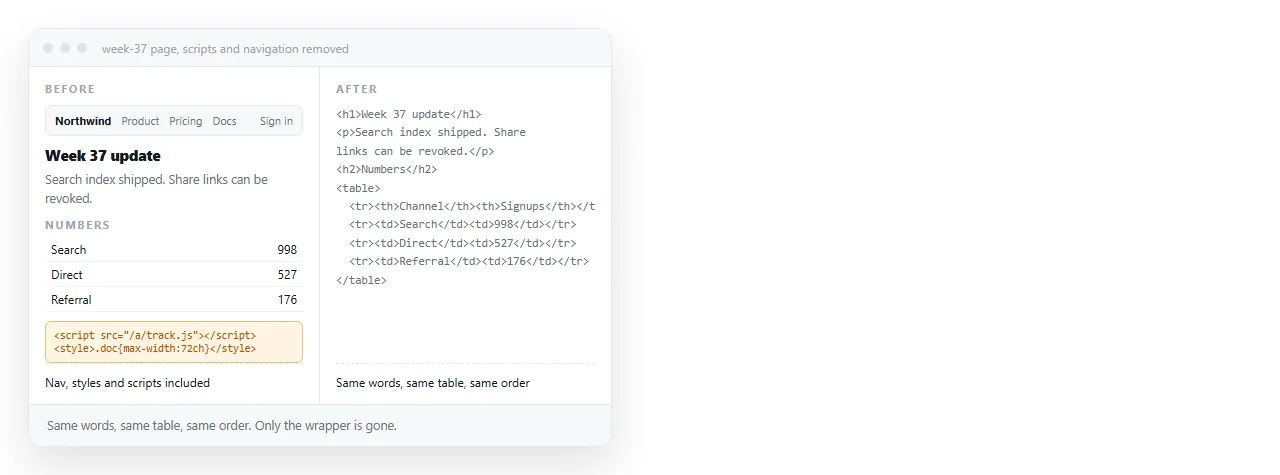
After that pass, HTML is often only modestly longer than the markdown version, and it still carries the structure. That is usually a better position than either extreme.
The cases where HTML clearly wins
Irregular tables. Financial statements, timetables and specification sheets frequently use merged cells. Keep the HTML for those.
Anything the model must act on. If the next step is clicking or filling a field, the identifiers must survive. Converting removes them.
Pages where design is part of the question. Asking why a layout breaks on a phone requires the markup and the CSS. A description of the layout is not a substitute.
Round tripping. If you want an edited version of a page back, paste the page. Otherwise you get a new page with similar content, which is a redesign rather than an edit.
Output format is decided separately
A common error is letting the input format choose the output format.
| Result goes to | Ask for |
|---|---|
| A repository file or ticket | Markdown |
| Another prompt | Markdown |
| A person opening a page | A complete single file HTML document |
| A plain text field | Plain text, written for that field |
Getting HTML instead of markdown covers the prompt shape when the answer keeps reverting. Going the other way, ChatGPT HTML to text covers extracting the words from a page you already have.
Semantic tags are where HTML pays off
If you are going to spend characters on tags, spend them on tags that mean something.
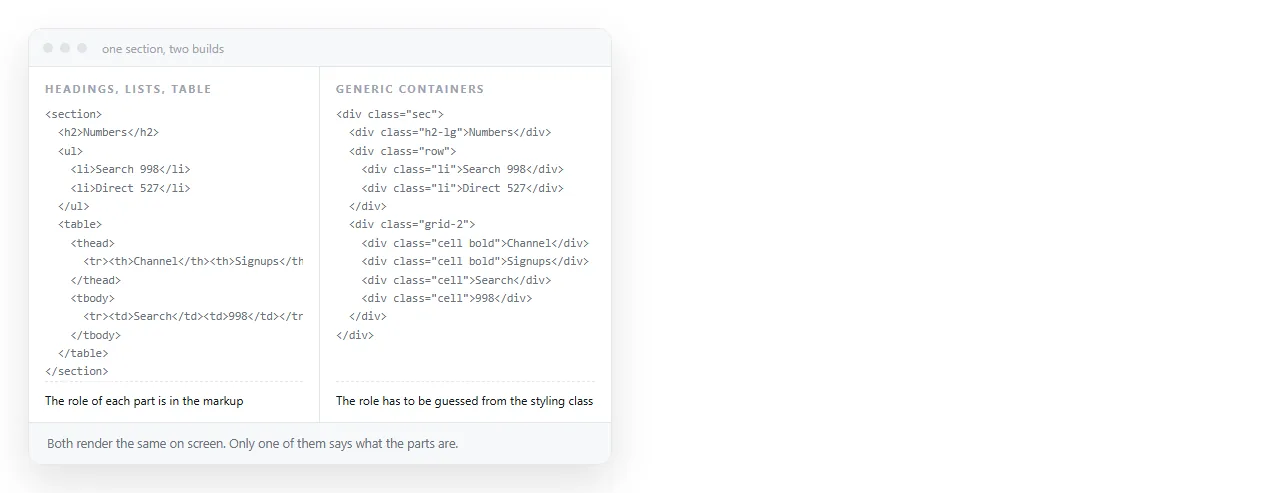
Headings, lists, tables, sections and articles tell a reader where content begins and ends. Generic containers with styling class names tell it very little, at similar cost.
That is the same property described in semantic HTML, and it is worth applying to pages you generate, because those pages get read back into models later.
When the page is the deliverable
If the output is a page rather than an input, the format question ends and a delivery question starts. An HTML file is awkward to send, since attachments get filtered and phones will not render them.
Pasting it into a NOS document renders it exactly as written, including dark theme, charts and scripts, and gives the page its own address through Share, then Share link, then Create link.
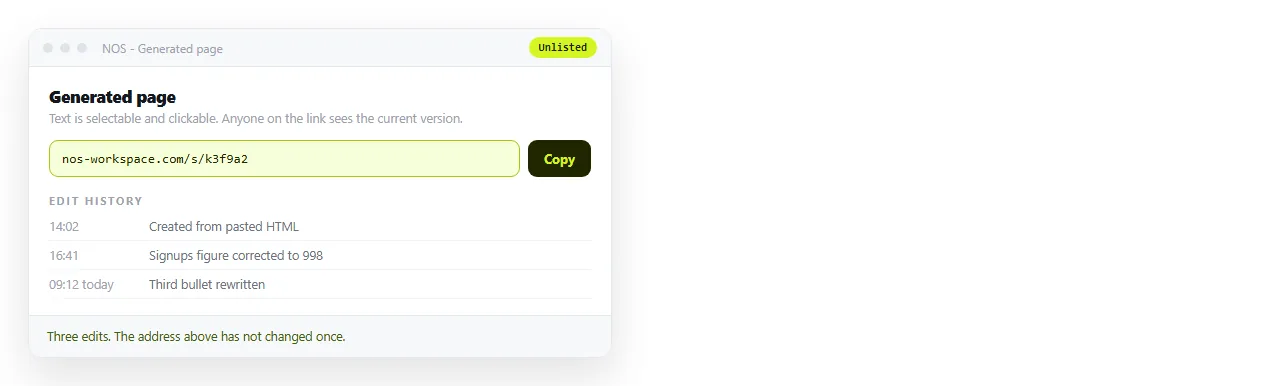
The link is unlisted by default, so only people who have it can open it. Because the address survives editing, corrections happen in the page rather than in a second message.
Turning HTML into a link is that step alone, and the HTML viewer is the quick check before you commit to it.
Short version. Default to markdown. Pay for HTML when the document has irregular tables, elements to act on, attributes with data, or a design that is part of the question.
Clean the HTML before pasting either way, because most of a real page is not content.